









Wolverine for hunters and outdoorsmen
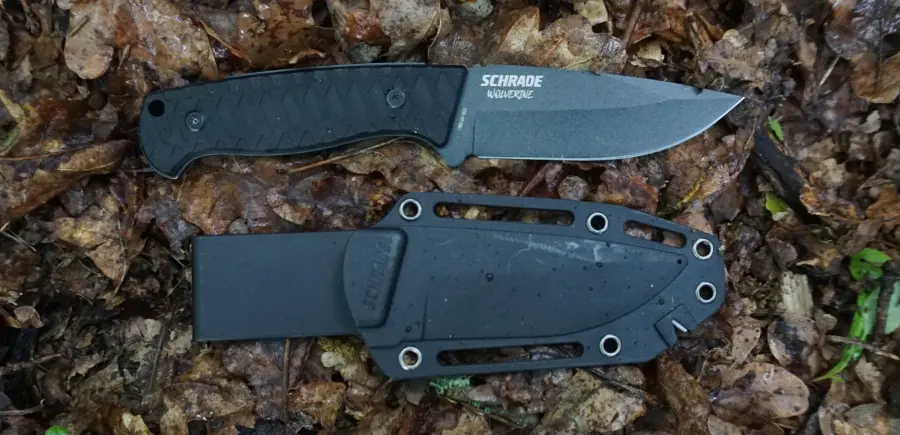

We’ve already reviewed several knives from the Schrade brand, especially folders and skinning knives. This time, we’re offering a hands-on test of a versatile fixed blade workhorse you’ll find in stores under the name „Wolverine Fixed Blade“.
Cover photo: Schrade Wolverine Fixed Blade Knife.
Wolverine may be primarily designed for outdoorsmen, but it also earns its place on a hunter’s belt without compromise. In our long-term test, it particularly stood out in field dressing and game processing—key tasks for hunters and gamekeepers. At the same time, it’s a true all-rounder for any job, which usually brings with it some painful compromises. So how does the Wolverine perform? We put it through several months of field testing, both during hunts and bushcraft trips.
Full-Tang Construction
The tested knife has an overall length of 212 mm, with a blade length of 95 mm. The manufacturer states a blade thickness of 3.3 mm, but on the tested unit, it was actually 0.4 mm thinner. The blade features a drop point profile and is made from AUS-10 stainless steel—the highest quality in the AUS series. It sharpens easily, holds an edge well, and resists wear and corrosion. While not considered premium, it’s one of the best steels in the budget knife segment and certainly superior to the ubiquitous 440C. Additionally, it features a protective and especially “non-stick” Teflon coating. Structurally, it’s a true full-tang knife—the blade extends the full length and profile of the handle, with the handle scales simply screwed on. The benefit is significantly higher strength compared to a traditional narrow tang, with only a slight increase in weight. The knife itself weighs 180 grams, so nothing excessive. The handle scales are made of virtually indestructible and water-resistant G10 composite, featuring a deeply machined anti-slip texture. It fits comfortably in most average-sized hands, whether you're right- or left-handed. At the end of the handle, there’s a lanyard hole and jimping on the spine for thumb placement.
A Handy Feature
The sheath is made of matte black polymer, holding the knife securely via friction lock—providing an ideal balance of retention and ease of draw. A standout functional feature is the built-in sharpener, simple yet fully functional and safe to use. Just pull the blade through it a few times. Naturally, it won’t give you the edge quality of a whetstone—it’s a basic pull-through sharpener (which some knife enthusiasts scoff at), but it works. For our hunting or outdoor needs, it's more than sufficient. During game processing, this allows for quick touch-ups on the edge without having to carry a separate sharpener.
The knife attaches to a belt via a spring steel clip, making it quick and easy to put on (for belts up to 53 mm wide and 3.5 mm thick) without removing your belt or threading it through the sheath. You don’t even need a belt—the Wolverine clips securely onto a pants waistband. The downside is a slightly higher risk of losing the knife; however, I’ve never had that issue. If you don’t trust the clip, the sheath can also be secured by threading a belt through two elongated side slots, although this positions the knife higher on the waist. Alternatively, you can use the six eyelets for a lanyard.
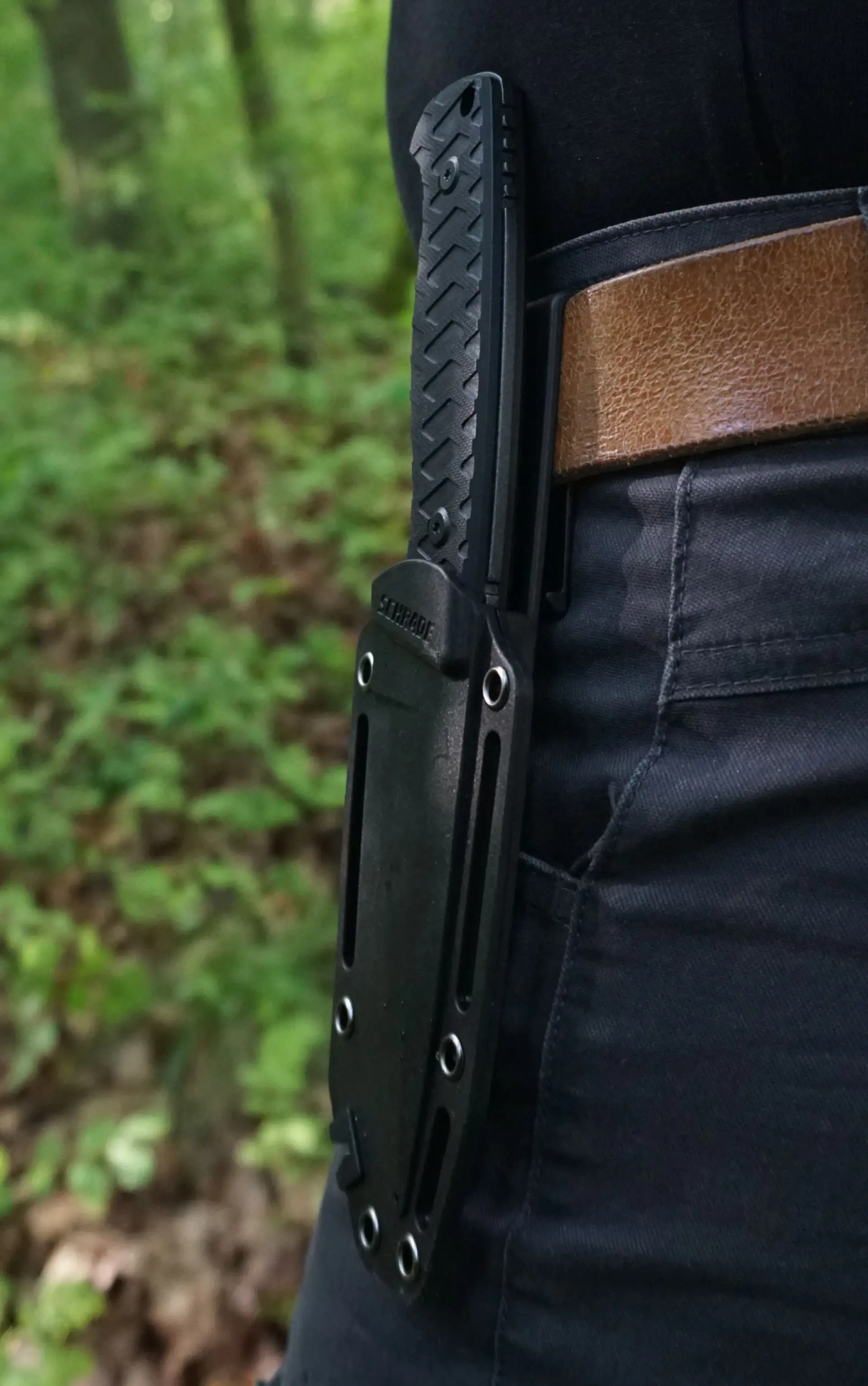
Thanks to the clip, the sheath can be attached to a belt without threading.
The blade length offers an ideal compromise—suitable for finer work as well as deep cuts.
Excellent Performance
I first tested the knife’s capabilities during several bushcraft outings, performing typical tasks such as cutting various materials, rope, and skinning. Then I stabbed it into softer wood and pried sideways to test the tip’s resistance to deformation. I also processed firewood, including batoning larger logs. I tried finer tasks too, like food prep, and finally used it in combination with a ferro rod to start a fire. For that, the knife’s spine—with its rounded edge and coated surface—wasn’t ideal, but otherwise, the Wolverine performed excellently in all disciplines, proving its excellent usefulness for both bushcraft and general hunting tasks.
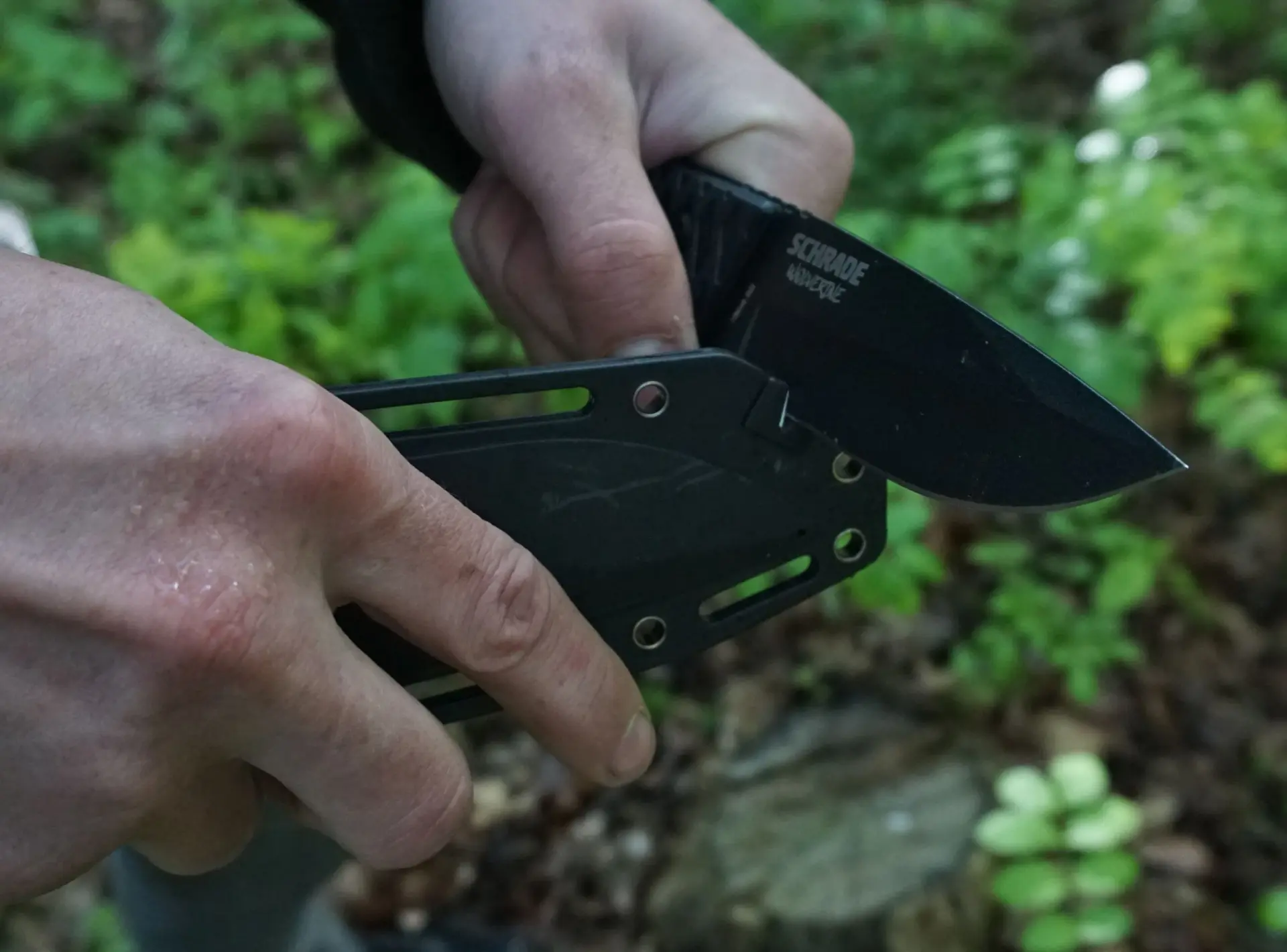
Quick edge touch-ups are easy thanks to the built-in sharpener.
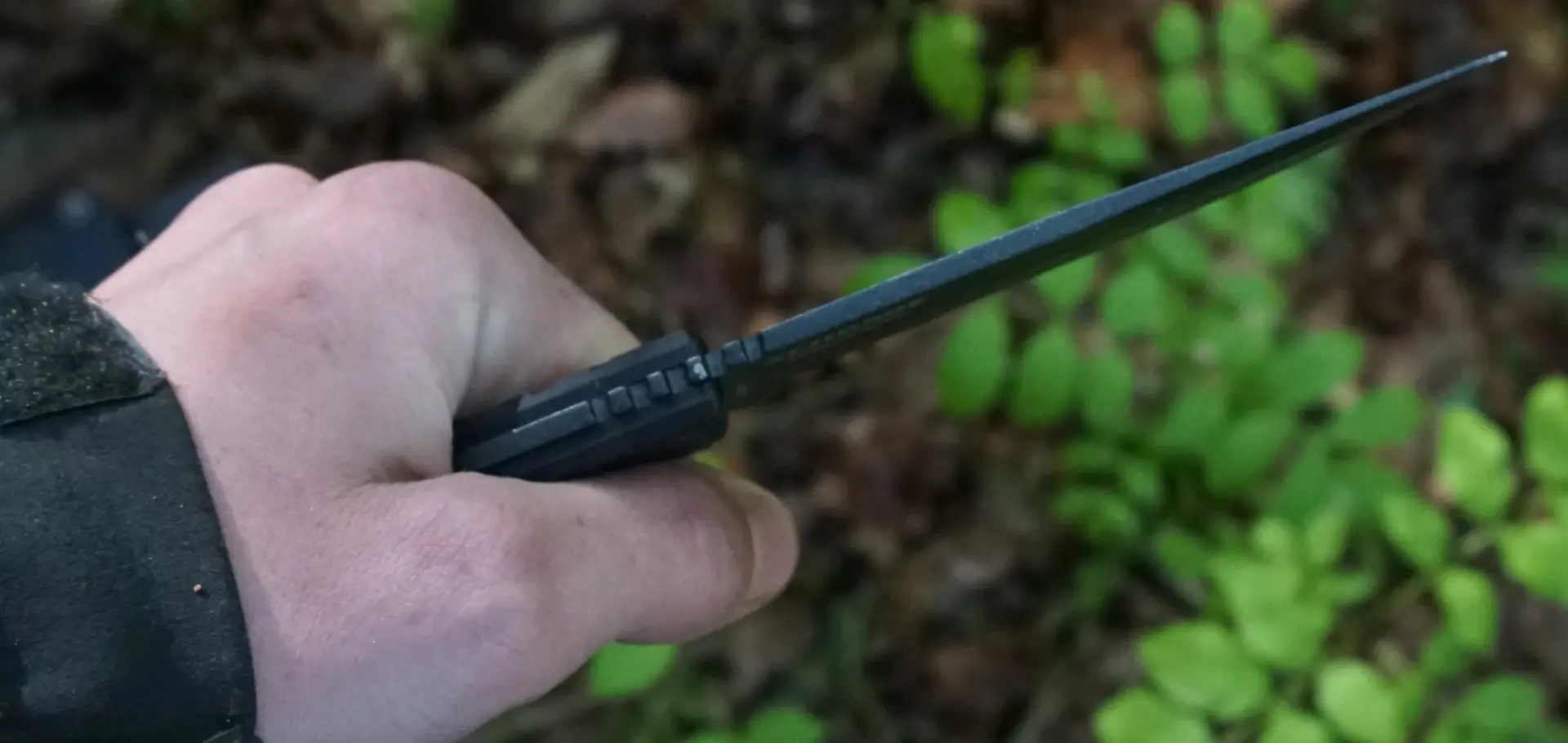
The only serious drawback—the handle is unnecessarily slim.
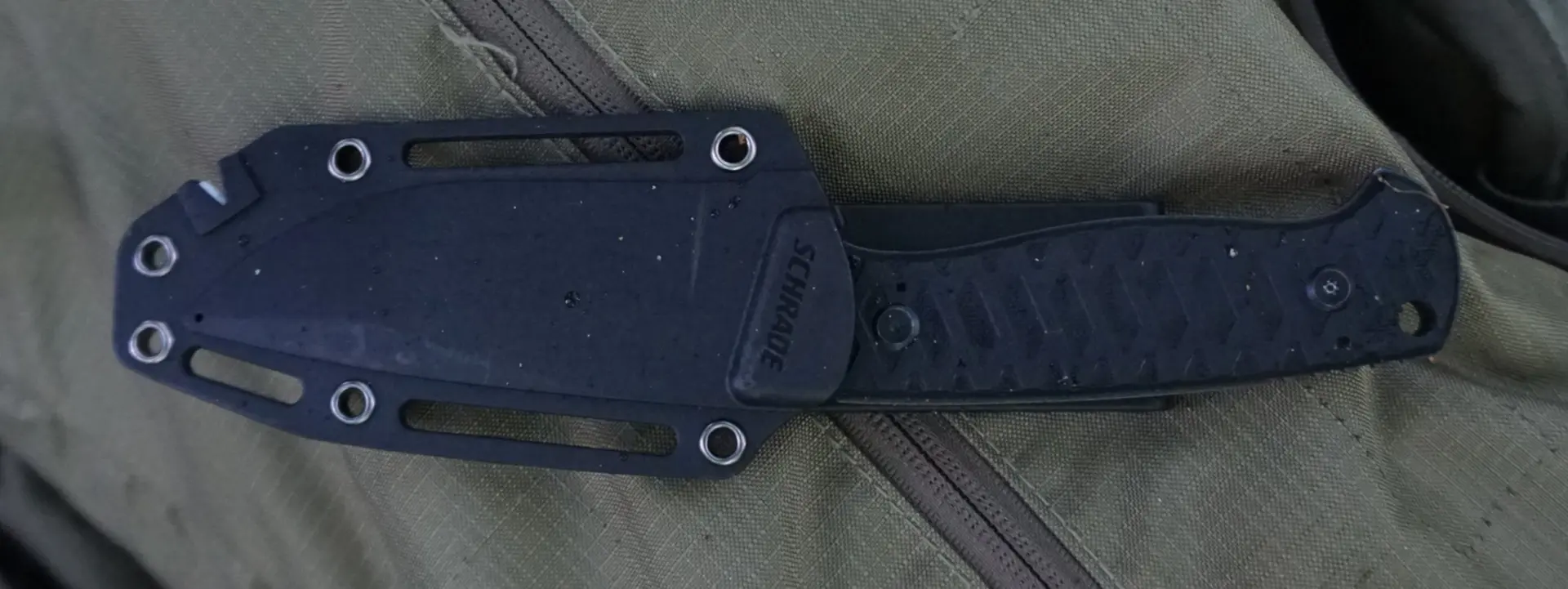
The knife and sheath are completely impervious to moisture.
A Compromise That Doesn’t Disappoint
The most important insights come from game processing. My experience includes field dressing a wild boar and a young roe deer, and I can say the knife performed honorably. However, one weakness must be mentioned—the slim handle is only 11 mm thick. While that improves carry comfort, it becomes uncomfortable during prolonged, forceful use, pressing uncomfortably into the palm. Processing a single animal is fine, but dressing multiple animals in one outing would likely be unpleasant. Another issue: the blade is relatively wide, disqualifying it for certain precise cuts, but it handles skinning and general butchering well. The blade length is a perfect compromise—suitable for detailed tasks as well as large cuts, including splitting ribs. It’s still a compromise, but if you want to do everything with just one knife, the Wolverine won’t let you down.
During field dressing, you’ll appreciate how securely the handle stays in your grip, even when your hands are covered in blood or fat. The finger guard between the blade and handle effectively prevents injuries. A big advantage is how easy it is to clean—the knife and sheath have no moisture-trapping areas or hard-to-clean nooks. The non-stick Teflon blade coating also prevents residue from sticking and allows for easy cleaning. Even if you don’t clean it, nothing happens. In practice, the blade, handle, and sheath proved completely resistant to moisture damage.
Advantages / Disadvantages
+ Well-balanced all-rounder
+ Excellent price-to-performance ratio
+ Smartly designed sheath
+ Doesn’t attract dirt
- Handle could be more robust
Verdict
As a hunting knife, the Wolverine performed excellently. If the handle were more robust, I wouldn’t have a single complaint. Yes, it’s a universal knife, so a dedicated skinning knife will surely perform better at that specific task, but overall, the Wolverine offers a well-balanced compromise in a single knife. I highly commend its resistance to dirt retention and the sheath with built-in sharpener. I believe the blade will stay sharp through the processing of a full animal, but the cleverly placed sharpener is always there for quick edge touch-ups. I was slightly thrown off by the discrepancy between the manufacturer’s stated dimensions and actual measurements. For bushcraft, the extra half-millimeter of blade thickness would be useful. However, from a hunter’s perspective, where game processing is the primary task, 2.9 mm is optimal—at least in my subjective opinion. It may seem misleading, but based on my experience with other Schrade knives where specs matched reality, I chalk it up to a marketing error. The Wolverine retails for CZK 1,023 and, considering the materials and quality, that’s more than reasonable. It’s also worth mentioning that if you prefer a smaller knife, the manufacturer offers the “Wolverine Mini Fixed Blade” with a 63 mm blade and a differently designed ergonomic handle.
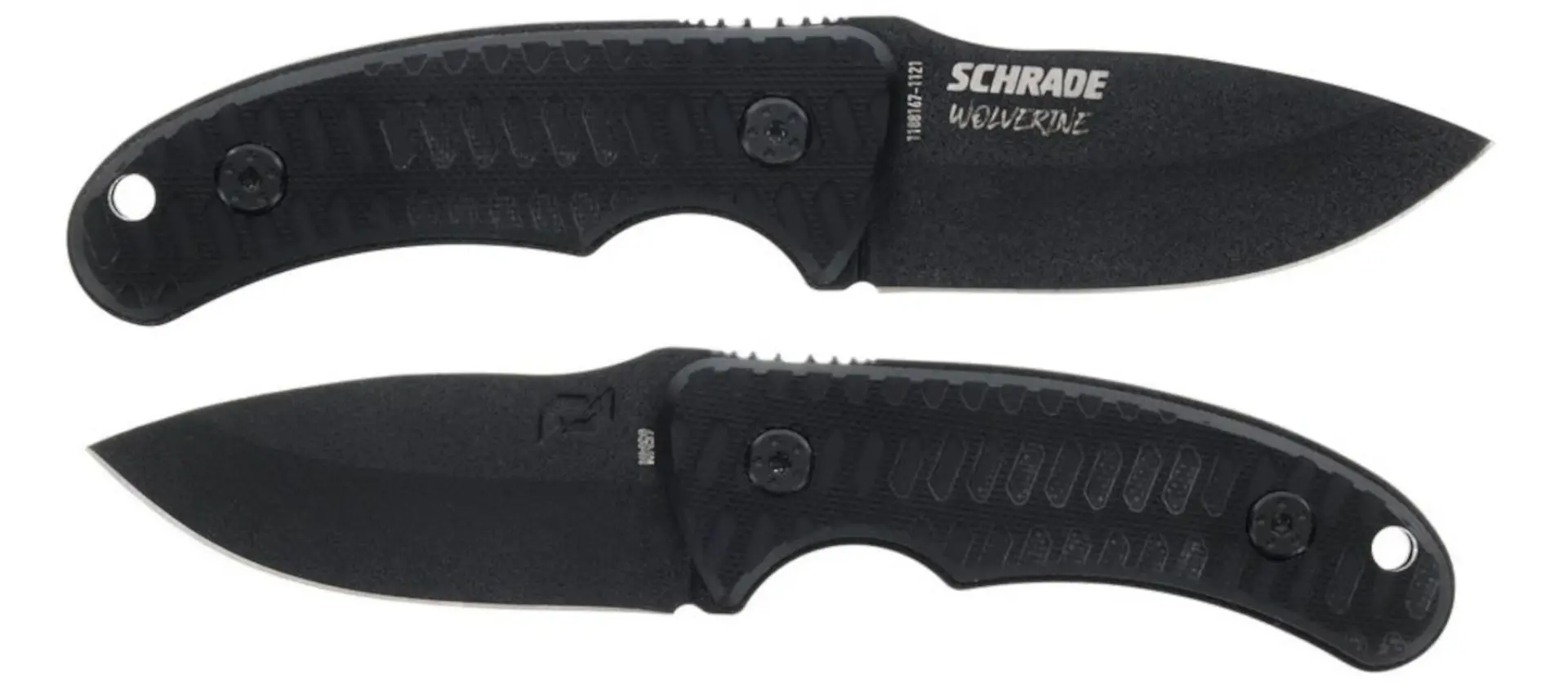
Smaller model Wolverine Mini Fixed Blade.
The Wolverine, like other knives from the Schrade brand, can be purchased at STROBL.CZ s.r.o. For more information, visit strobl.cz, or the manufacturer’s website schrade.com.
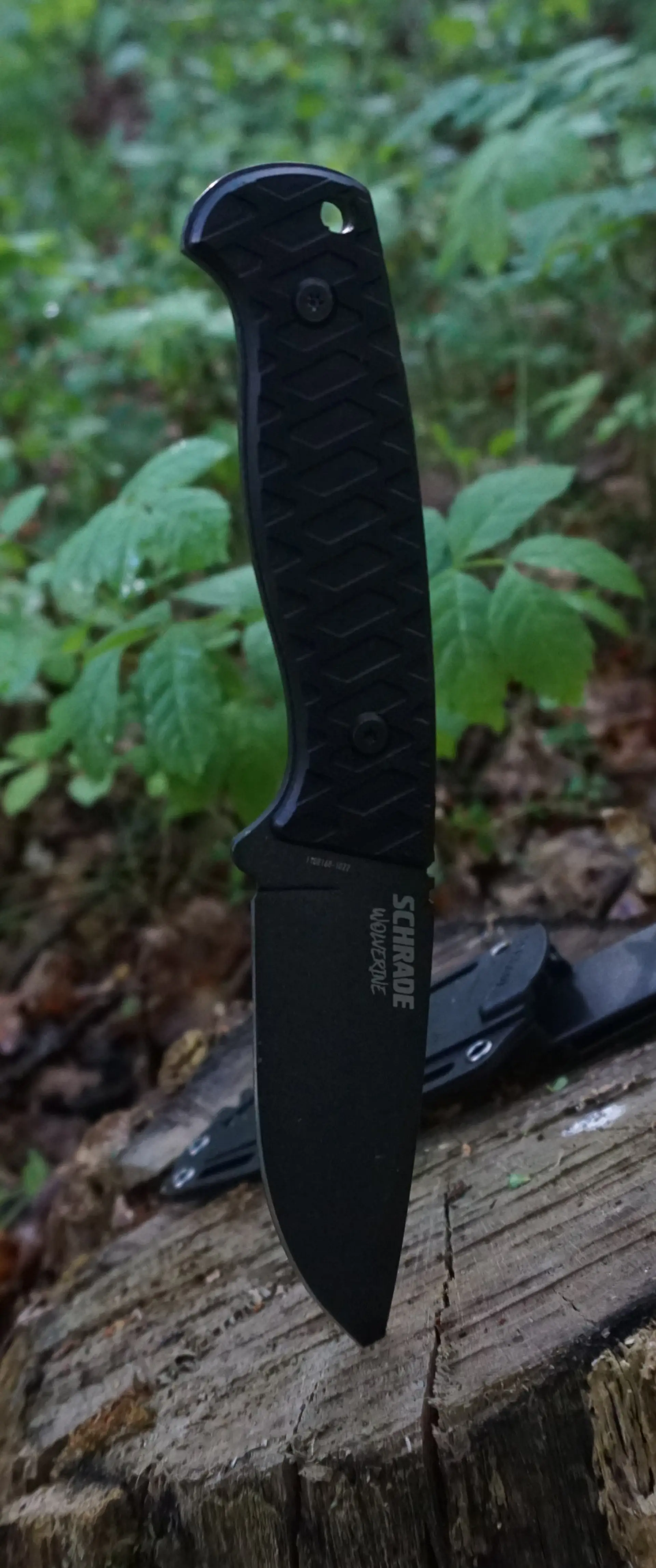
A typical “bushcraft” knife that still has a lot to offer to hunters.