









Backup red dot sight in hunting practice
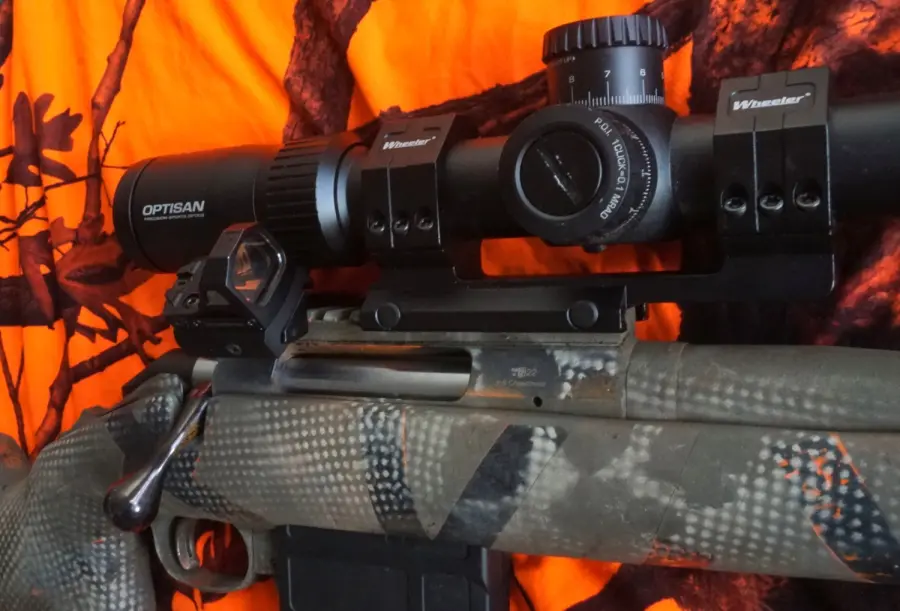

Carrying both a riflescope and a red dot sight on the same firearm is not very common in hunting practice and only a few hunters make use of it, but in certain situations it does have its advantages. In this article we will take a closer look at the whole concept.
Today’s hunting standard when it comes to aiming is the riflescope itself. For a long time, iron sights also “survived” on bolt-action rifles as a kind of backup, but most current models lack them due to their practical redundancy. For driven hunts, where shooting takes place at short distances, red dot sights have become popular as an alternative to universal but less responsive driven-hunt riflescopes (LPVO) when shooting at moving game. But what should you do if you want one rifle with a powerful riflescope, primarily for individual hunting at longer distances, while at the same time not giving up the option of shooting at extremely short distances with an emphasis on speed? The classic solution would be to take a rifle with iron sights and equip it with see-through scope mounts that allow aiming underneath the scope. Such rifles are still available on the market, but the selection is limited. A high mount, on the other hand, moves the riflescope farther away from the bore axis, which is problematic from the standpoint of ballistic compensation and ergonomics. An alternative is adding an open micro red dot sight next to or above the riflescope. The same solution can be found quite commonly in the military/tactical shooting field, but not in hunting. Most hunters simply do not make use of anything like this, just as they do not use see-through mounts. For specific hunting scenarios, however, it is certainly an interesting option that deserves to be better known, so we will at least briefly introduce it here for those who may be interested.
 Aiming method with a side mount.
Advantages and disadvantages
I personally encountered this on a hunting ground in Africa. An owner specializing in culling wild pigs had a red dot sight mounted on the side of his bolt-action rifle with a powerful riflescope for follow-up shots, and he spoke highly of his solution. I myself have experience with such a configuration from sport shooting, and once you get used to it a bit, it really allows you to react very quickly to unexpected dynamic situations at close range.
Compared to iron sights, a red dot sight has the advantage of faster target acquisition and noticeably better aiming in poor lighting conditions. There are certainly shooters for whom a red dot sight never feels right, and an eye condition may be the reason, but most shooters agree that overall better accuracy and faster times can be achieved compared to “irons.” In addition, when selecting scope mounts you do not have to limit yourself to high see-through types. Iron sights are of course less delicate compared to complex devices combining electronics and glass, but the quality of red dot sights, even inexpensive ones, has increased dramatically in recent years. They can withstand really rough handling and adverse weather, and their batteries literally last tens of thousands of hours of operation. The increase in firearm weight is negligible. For example, one of my red dot sights, the UTG OP3, weighs a total of 57 g including the side mount. A greater disadvantage may be the space requirements, as the red dot sight sticks out slightly from the rifle’s outline. Another drawback worth mentioning is the financial aspect. Decent red dot sights start at around CZK 4,000, but they can climb to double or even triple that. When choosing one, you want something small and open that does not take up much space on the firearm.
Author’s choice
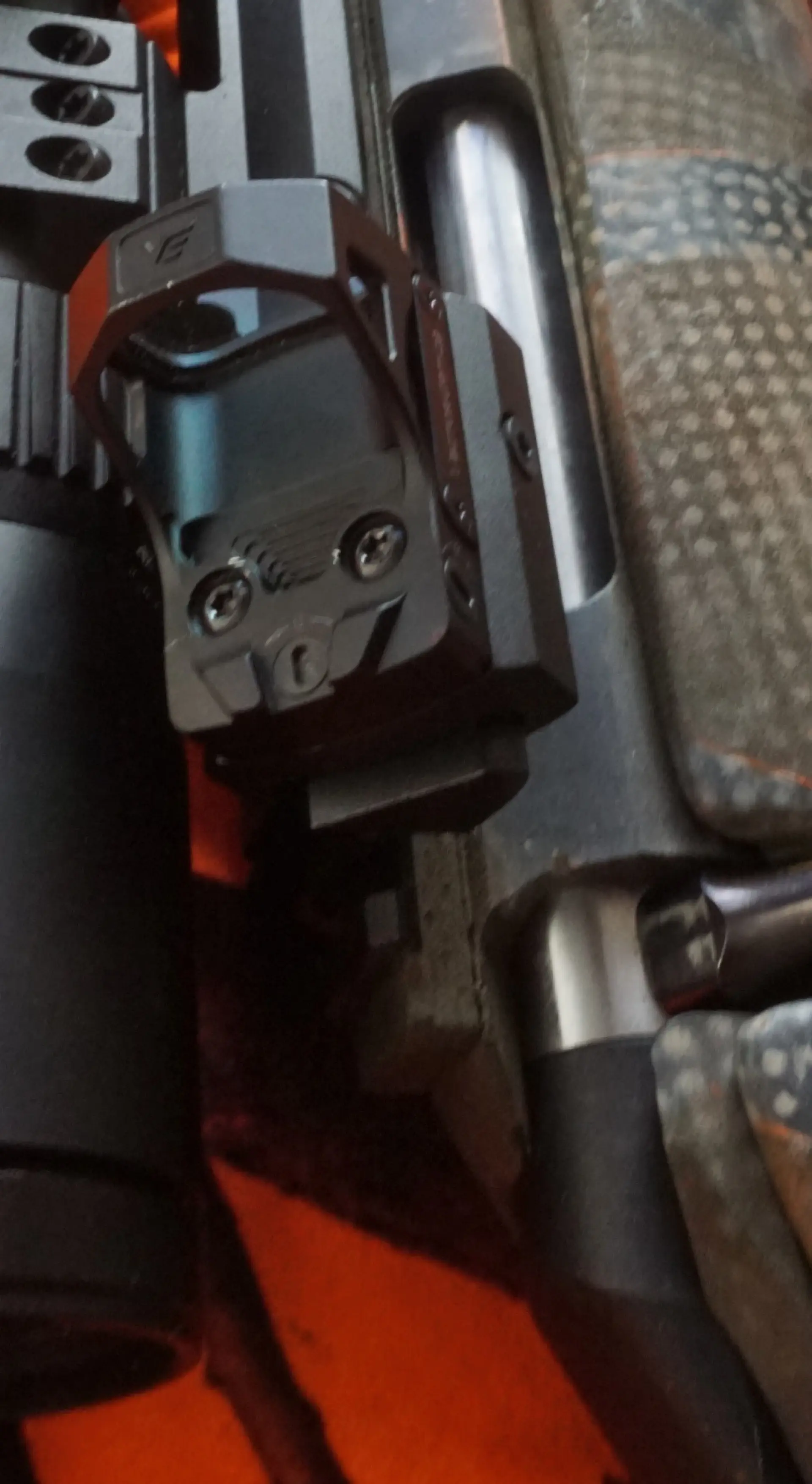
If you decide on an angled mount, from my own experience I can recommend the “45° Offset Picatinny” type from TruGlo. Thanks to its symmetrical design it can be mounted on either side of the firearm, it is minimalist and weighs only 30 g. It is also very low, only 4.5 mm above the level of the firearm’s mounting base, so it fits under most riflescopes, which certainly cannot be said about all offset mounts on the market. It reliably holds zero (I tested it in combination with rifles chambered in 6.5 Creedmoor and .444 Marlin) without noticing any shift. The quality is more than decent and the price is a reasonable CZK 812.
 “45° Offset Picatinny” mount from TruGlo.
„Most hunters will not make use of something like this, but for specific hunting scenarios it is an interesting and in many respects more valuable alternative to see-through mounts and iron sights!“
Mount selection
When it comes to mounting, you must decide where the red dot sight will be attached. There are essentially three options: an offset mount that attaches to the same base as the riflescope. Next is a special mounting ring that clamps directly onto the riflescope and contains a mounting base for the red dot sight, and the final option is attaching the red dot sight to the handguard. However, this assumes that your firearm has a handguard with a mounting interface, which is rarely seen on hunting rifles, so we can disregard that option. Besides versions using the Picatinny standard, mounts are also available with an interface (footprint) to which the red dot sight attaches directly without an intermediate plate. The advantage is savings in size and weight, while the disadvantage is lower universality. There are several mutually incompatible footprint types (Docter, RMR, RMS, ACRO and others), so more careful selection is required.
Which type of mount should you choose? Mounting to the riflescope interferes less with handling the firearm compared to a side mount, and you do not need free space on the base and are not limited by the bolt handle and the ejection port as with an offset mount. On the other hand, placing the red dot sight above the optic means moving it quite high above the bore axis. For this reason, for hunting use I personally lean somewhat toward side mounts, but it is purely a subjective choice depending on what suits the user better. A side mount also allows attaching a thermal or night vision device next to the riflescope, provided the dimensions of the device allow it. The advantage of such a solution is a wider and cleaner image than with a clip-on device, without having to swap the night vision unit with the riflescope. All in all, it is a rather niche solution, but it may suit some users.
There are countless mounts for both options available on the market at various price levels. Personally, I have very good experience with the “45° Offset Picatinny” angled mount from TruGlo, see the box. On my self-loading rifle of the SPR AR-15 type I use a combined UTG Accu-Sync mount with an additional Anti-cant Leveler II interface and I am thoroughly satisfied with it, but this is not a hunting application.
 When using side mounts on a bolt-action rifle, care must be taken during placement to ensure that the red dot sight does not obstruct the ejection of cases or the bolt handle.
 A firearm with a side mount must be tilted to bring the eye into alignment with the red dot sight.
Aiming and its pitfalls
How do you actually aim with it? In the case of a red dot sight mounted above the riflescope, you aim as usual, just with your head slightly raised. Of course, this comes at the expense of an ideal cheek weld, but at the distances at which the red dot sight will be used it does not result in any noticeable loss of accuracy. The main issue is zeroing, because the red dot sight will sit significantly above the bore axis while at the same time you will want to use it at short distances. It makes sense to zero it at around 25 meters, but you must also take into account that when making follow-up shots at 5 meters, for example, your point of impact will be noticeably lower.
With a side mount this problem disappears, but when aiming you must tilt the entire firearm around its axis by roughly 45° in order to bring the red dot sight in line with your eye. It takes a bit of training before it becomes second nature, and at first it may feel somewhat unnatural, but it is something you can get used to.
So if you have concluded that a backup red dot sight would be beneficial for your specific hunting practice, there is no reason not to give it a try. As we have said, it is not a solution suitable for every hunter, but for some it may in fact be the ideal setup.