









So It Doesn’t Blow Up – Powder Charge Control
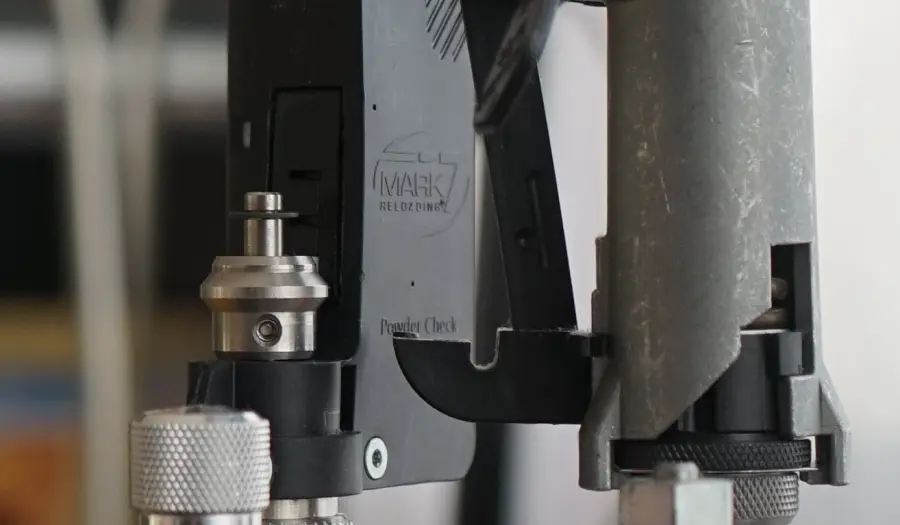

Powder charge verification is one of the essential, yet relatively time-consuming operations in ammunition reloading. However, there are devices that can make this task much easier.
Reloading on a high-performance progressive press is much faster than on a single-stage press or a turret press, but it also has its downsides. One of them is somewhat reduced operator control over inspection processes; in other words, the smooth workflow can tempt the operator to skip certain checks. When reloading “for volume,” most shooters simply accept a certain level of inaccuracy as a reasonable trade-off for speed. For example, with bulk-loaded 9mm pistol ammunition, if you maintain a reasonable margin below maximum pressure limits, it is usually sufficient to check the powder charge and bullet seating depth only occasionally. A tenth of a grain here or a fraction of a millimeter there will usually not make a noticeable difference in the final result. What does make a difference, however, is a situation where the press momentarily jams, you cycle the handle again, and fail to notice that the case now contains a double powder charge. This is a very dangerous situation that can result in firearm damage and shooter injury. Similar consequences can also be caused by a powder charge that is too low or completely absent. In the first case there is a risk of explosive combustion; in the second, the primer alone may push the bullet into the bore where it becomes lodged. When the next round is fired, another bullet—this time properly accelerated by powder—strikes the obstructed one, and a bulged barrel is the likely result. One may hope that such a problem would be noticed during shooting and resolved safely, but in dynamic competitions, where every second counts, most shooters will not stop to investigate—they simply rack the slide and pull the trigger again.
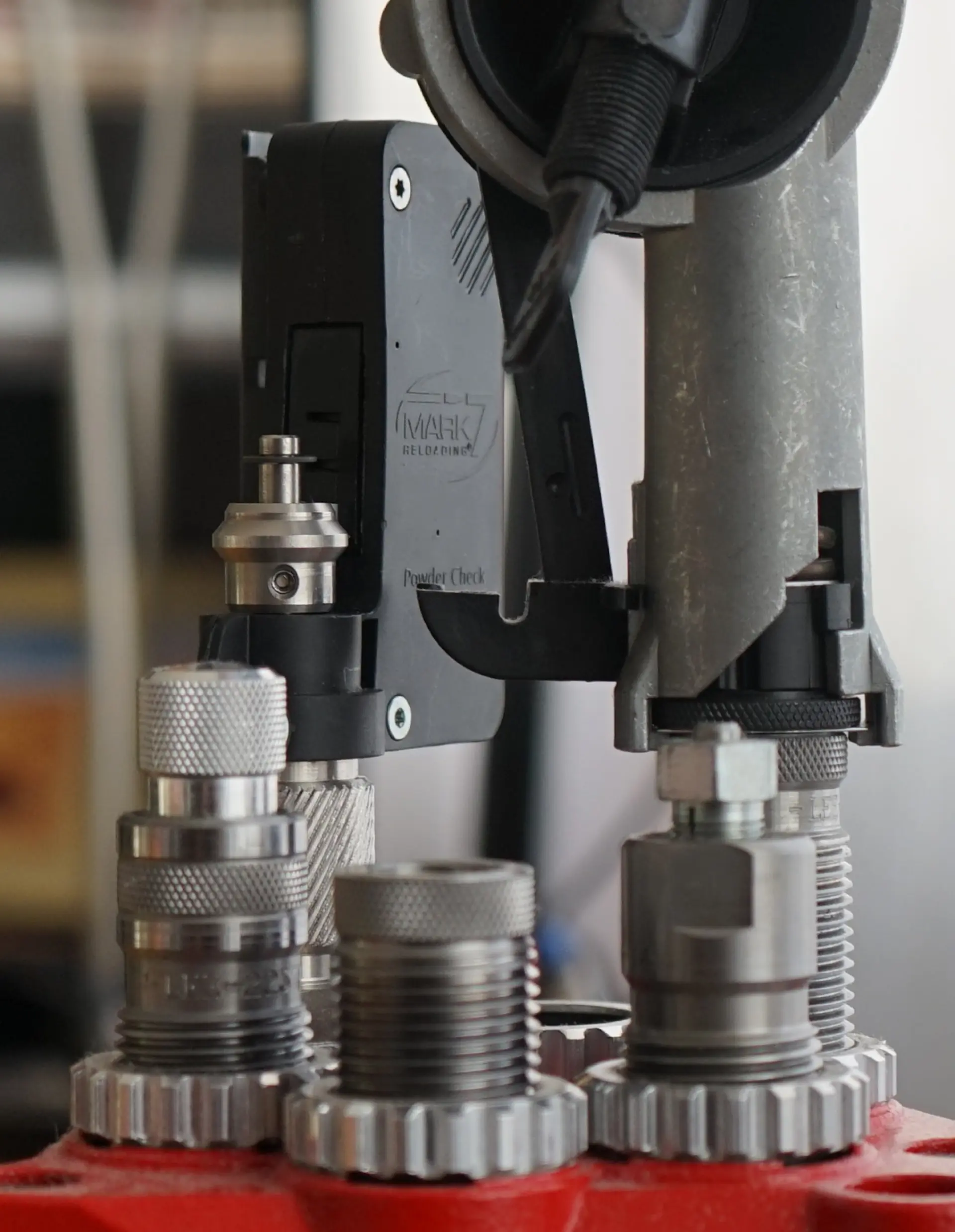 A powder charge verification alarm is a small and often overlooked, but very useful component of progressive presses.
Mechanical vs. Electronic Alarm
These potentially very dangerous situations can be prevented with proper monitoring. Weighing every powder charge, however, is time-consuming. With some cartridge cases, a quick glance can reveal whether powder is present and whether the case is not filled to the brim, but this approach obviously has its limits. It requires concentration, the correct viewing angle, and sufficient lighting—conditions that complex progressive presses often do not provide. An alternative is powder charge verification using a dedicated measuring device—a powder check alarm. This device is typically installed in a free station on the press toolhead after the powder measure die and provides the reloader with a visual or audible signal if the case contains no powder, if the charge is too small, or if it is excessively large.
A purely mechanical solution is offered, for example, by the RCBS Powder Checker die. A probe runs through its center—essentially a simple rod. When a case enters the die during the reloading cycle, the lower end of the rod rests on the powder charge and is pushed partially out of the die. Another rod on the die functions as a simple scale against which the probe movement can be compared, allowing you to determine whether the powder level in the case is too low or too high. The advantage of this solution is its simplicity and relatively low price (1,508 CZK), while the disadvantage is the need for visual inspection during every cycle, which can become rather inconvenient on fast progressive presses.
An alternative is an electronic alarm that requires nothing from the operator once it is set up—you do not need to watch anything or concentrate on the process, and if a problem occurs, the device alerts you with a clear audible signal. It is somewhat more expensive than purely mechanical alarms, but no less reliable. The electronic section consists of a simple circuit with a pair of mechanical switches, leaving very little that could actually fail. It is sufficient to check the battery before use, but power consumption is so low that replacement will not be needed very often. Accuracy is also significantly higher. A quality, properly adjusted alarm will trigger even with relatively small deviations from the optimal powder charge volume. At the same time, approximate visual inspection remains possible, similar to the RCBS system. The only technical downside is slightly more complex setup, and before purchasing you should also verify that there is enough space for the alarm on your press toolhead. In conclusion, it is worth noting that regardless of which alarm you choose—no matter its price or sophistication—you should still occasionally weigh your powder charges. This allows you to verify that the charge has not changed even within a range below the alarm’s detection threshold, and also because one can never be too cautious.
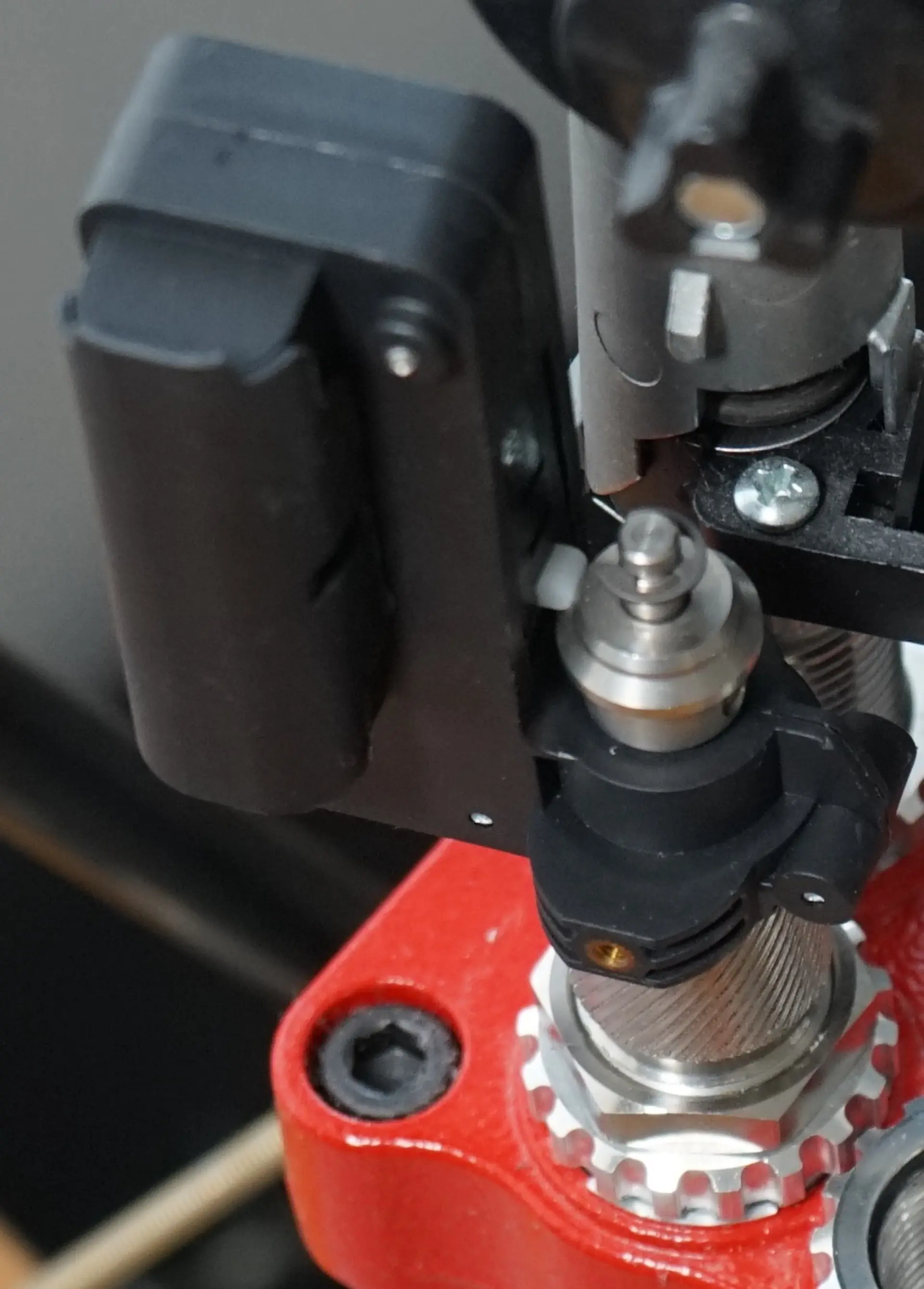 The initial setup can be somewhat confusing.
Lyman Powder Check
One of the handful of electronic alarms available on our market is the “Mark 7 Powder Check Alarm” from Lyman, which I had the opportunity to test over a longer period.
At first glance, the alarm is very well manufactured with clear attention to detail. Everything fits properly, the surfaces are smoothly machined, and all moving parts operate smoothly. I have no complaints in this regard. An advantage is its flat design, which fits most toolheads. The electronic unit is powered by a single AAA battery.
Setup is relatively simple, provided you understand how the whole system works. First, you need to select the appropriate insert and probe for the cartridge you intend to reload. In total, you have four inserts and four probes to choose from, all included in the package. The supplied manual contains a table indicating which components should be used for specific cartridges. The list is not exhaustive, but it is sufficient to give you an idea of what to use for cartridges not explicitly listed. It should also be noted that the list is not absolute. I base this on the .300 Blackout cartridge, which according to the manual should work with the large insert, but in practice the medium size is required.
The electronic module contains a switch activated by the insert. When the press ram is raised, the case pushes against the insert, lifting it and causing the alarm to start beeping. The second switch interacts with the probe running through the center of the insert. During the cycle, the probe contacts the powder charge in the case, which lifts it slightly. At the top of the probe there is a collar that interacts with the second switch. Its function is to deactivate the alarm if the powder charge volume in the case corresponds to the set level.
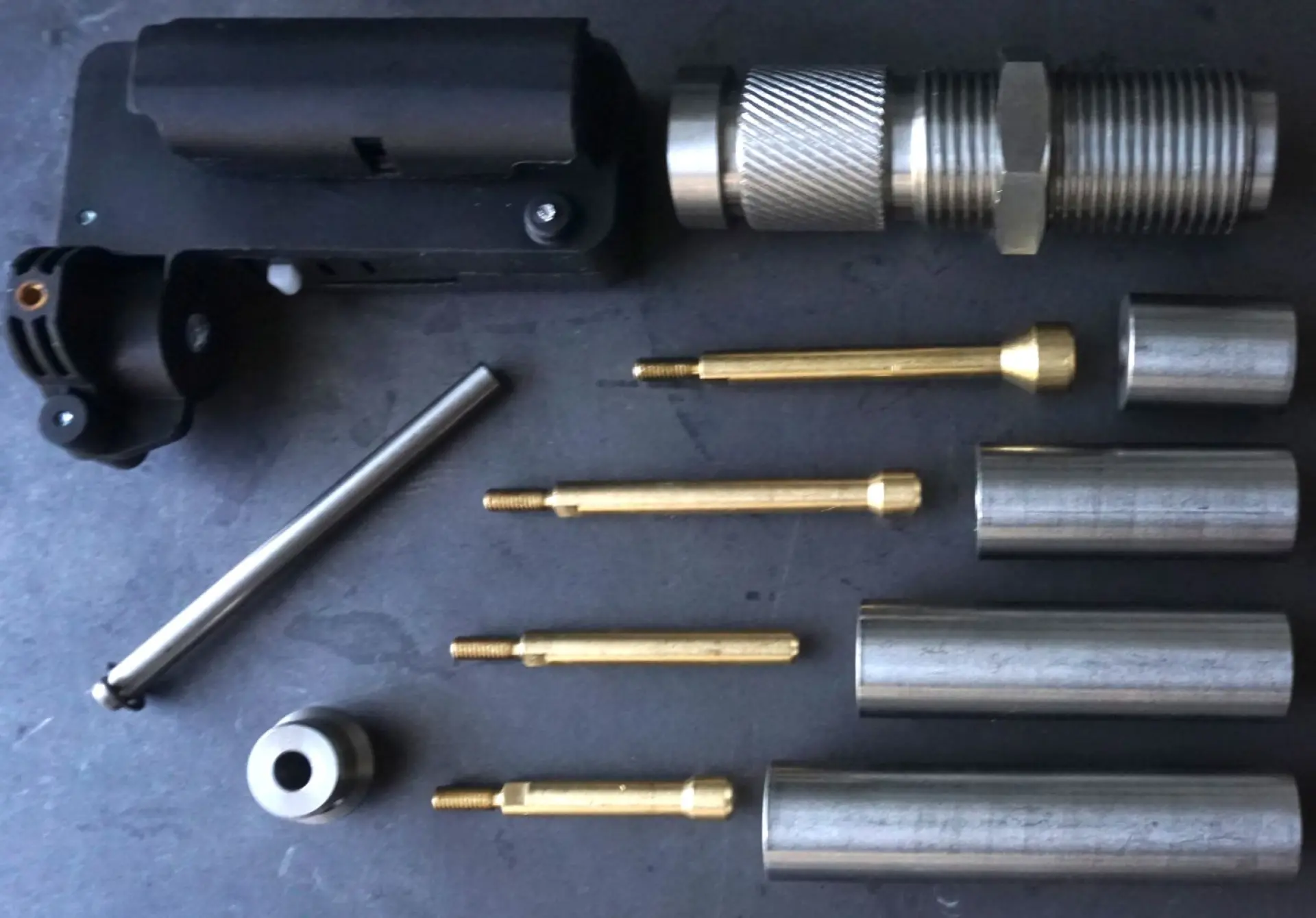 Package contents.
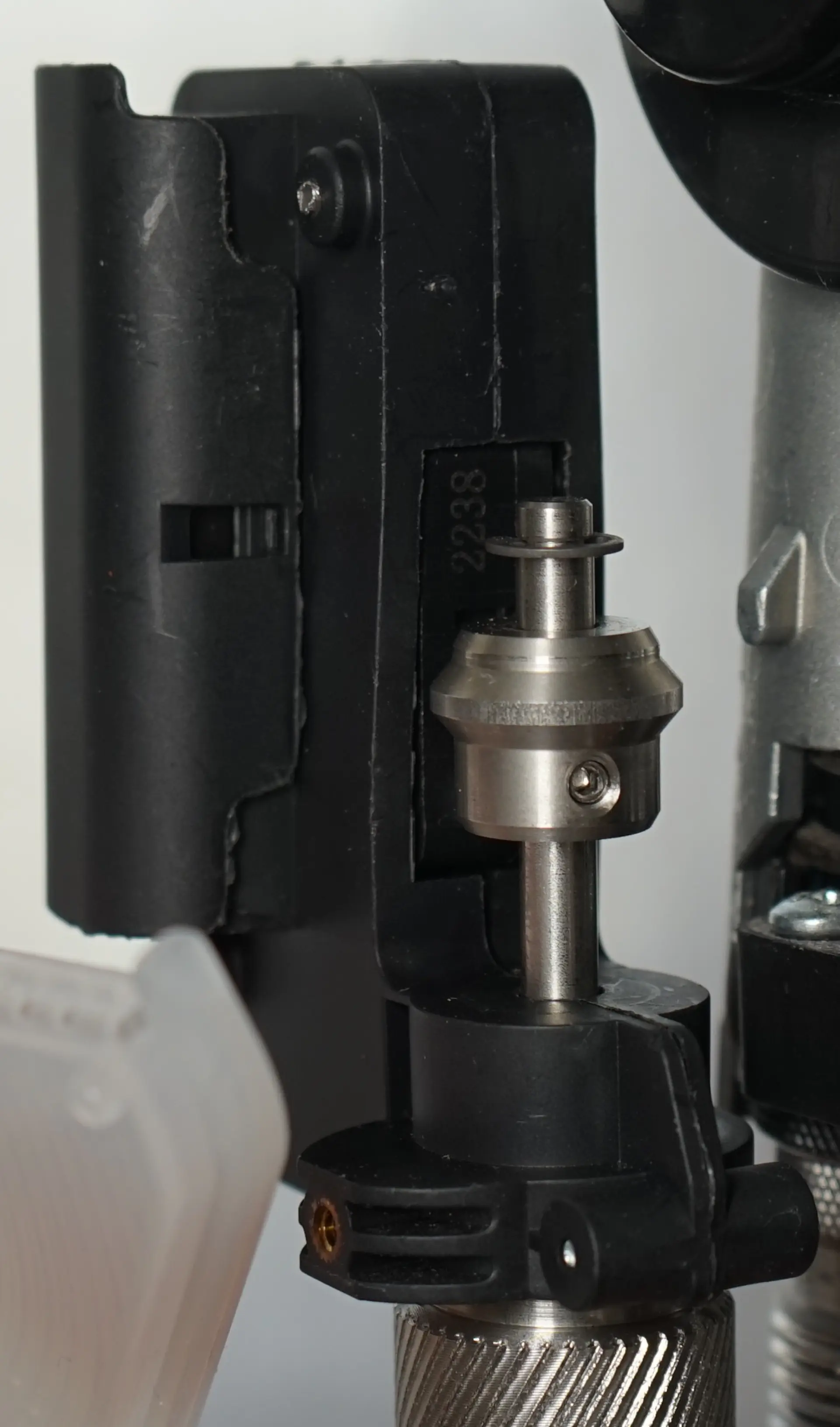 When correctly adjusted, the ring pushes the switch that blocks the alarm when the press ram is fully raised.
It works perfectly!
You screw the die body with the selected insert installed and the electronic module attached into the press toolhead with the ram raised and a case (containing the correct powder charge) in the shell holder. Screw the die down until the alarm is activated. In this position, lock the die in place with the lock ring. Then adjust the ring at the top of the probe so that it presses the second switch and thus disables the audible signal. Make sure that the rib on the ring is precisely aligned with the switch, and the setup is complete. If the powder charge is too low or too high, the ring will not deactivate the alarm, which will immediately alert you with a loud tone. The alarm sensitivity corresponds to just under 3 mm of probe travel. For example, with .223 Rem / .300 BLK cartridges and Vectan BA 9 ½ powder, the alarm is triggered by a deviation of less than 1 grain above or below the set value. I reloaded an estimated 3,000 rounds with it—a mix of .223 Rem, 9 mm Luger, and .300 Blackout—and I can confirm that everything works exactly as it should. I did not encounter any issues. Once you have it in your hands, the setup becomes straightforward. As far as I can judge, reliability is absolute. For the purposes of the test, I deliberately prepared about 20 incorrectly charged cases in all the mentioned calibers as well as 6.5 Creedmoor and .444 Marlin, testing them in a single-stage press. Whether the case had too little powder, too much powder, or none at all, the alarm responded correctly every time and never falsely triggered when the powder charge was correct. I have not yet had to replace the battery and overall I have nothing to criticize. Perhaps only the manual could be better—based on the supplied instructions I did not immediately understand how the system works and had to experiment a bit. Owners of fully automated presses may encounter a limitation, because this alarm does not have a function to automatically stop the press. The price is somewhat higher at 2,646 CZK, but considering the reloading speed it allows and the simplicity of use, it is definitely worth it, at least in my opinion.
The Lyman Mark 7 Powder Check Alarm can be purchased from STROBL.CZ s.r.o. More information can be found at strobl.cz, or directly on the manufacturer’s website lymanproducts.com
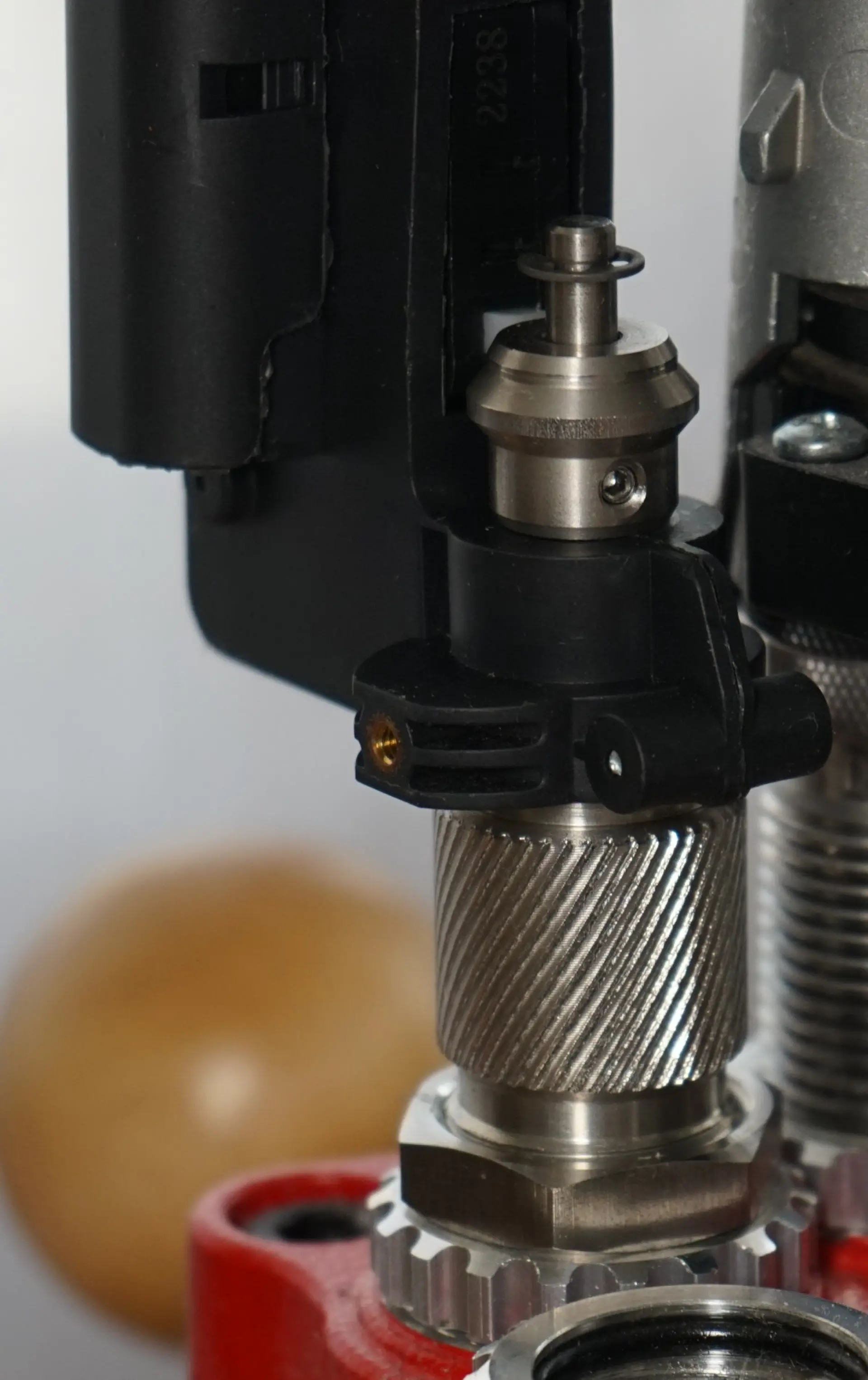 Detail of the ring positioned under the switch.
Photo sources: Author’s archive
Author: Tomáš Prachař
The article was originally published in Lovec magazine by Extra Publishing
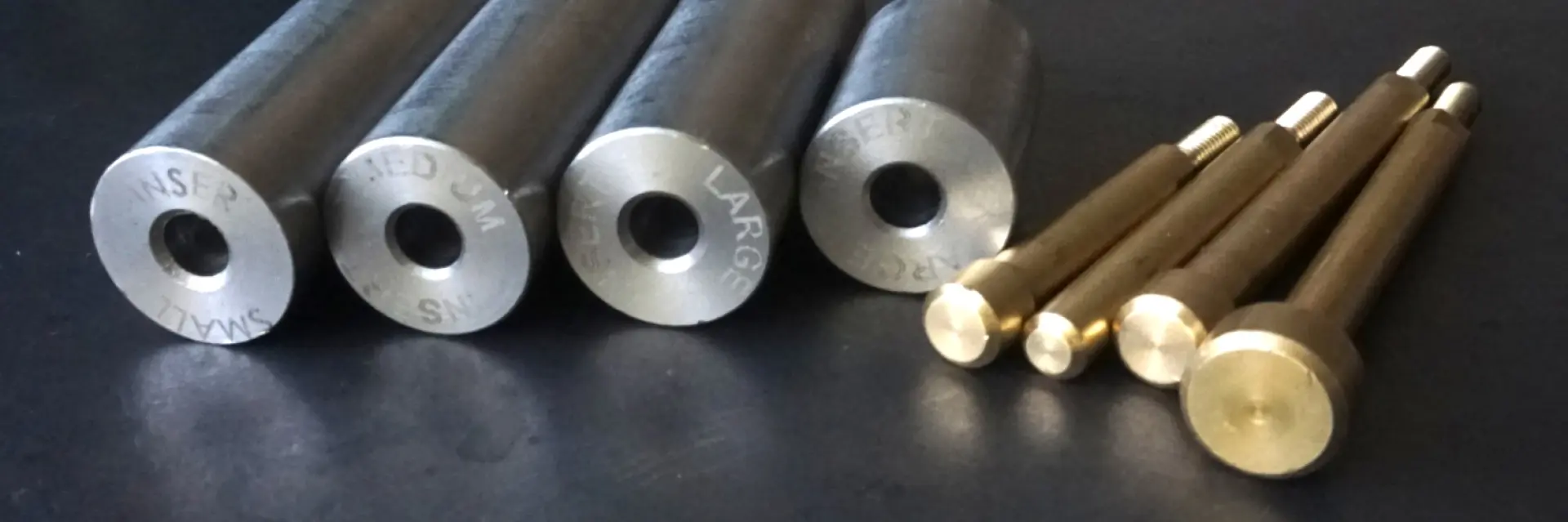 Set of inserts and probes.