







Basket is empty

Are you tired of shooting only at paper targets at the range and want to try something different? We’ve prepared a selection of popular alternatives that also bring a number of useful features.
Introductory photo – illustrative overview.
Most hunters train at the range or zero their “pride and joy” using paper targets. Often the classic international 55/20 pistol target, or cheaper airgun targets—and there’s nothing wrong with that. Personally, I often go even more economical and minimalist: using a plain A4 sheet with black adhesive pasters as aiming points, while a “pistol” target or more complex printed target that facilitates zeroing I use only at distances of 300 meters and beyond.
In any case, besides the classics, paper target manufacturers offer a wide range of options, but a large portion consists of targets designed for “tactical” shooting with silhouettes of human adversaries. Still, there are a few alternatives on the market aimed specifically at hunters, or with different intended use, yet still perfectly usable for our training. We will gradually introduce several such targets, with which we have long-term practical experience, in the following lines.
Adhesive targets
We’ll start with a simple and inexpensive, yet very practical solution. Don’t feel like hauling a stapler and a roll of large targets to the range when you just need to “chase” millimeters during precision shooting? A practical solution is self-adhesive targets that you simply peel off the backing sheet and stick onto the remnants of a previous shooter’s target. If you need to zero your rifle “from scratch,” a full-size target is preferable, but otherwise the adhesive alternative serves perfectly well. The one shown in the photo is made for the Strobl shop; each sheet contains 6 targets, each measuring 105×95 mm, and costs 9 CZK per sheet, so you’ll save compared to standard pistol targets. In addition, you avoid patching up the shot-out center of a large target—just stick another one a bit to the side and you’re good to go. From my own experience, I can confirm that the pattern is usable, depending on scope quality, even at 300 meters. Thanks to the grid with 10 mm squares and dimensions marked in MOA, it works excellently for zeroing. Specifically, the inner circle at 50 meters corresponds to a 1 MOA group, the second circle 2 MOA, and the inner edge of the third (outer circle) equals 5 MOA. At double the distance, this corresponds roughly to 0.5, 1, and 2.5 MOA respectively. Complete satisfaction from my side.
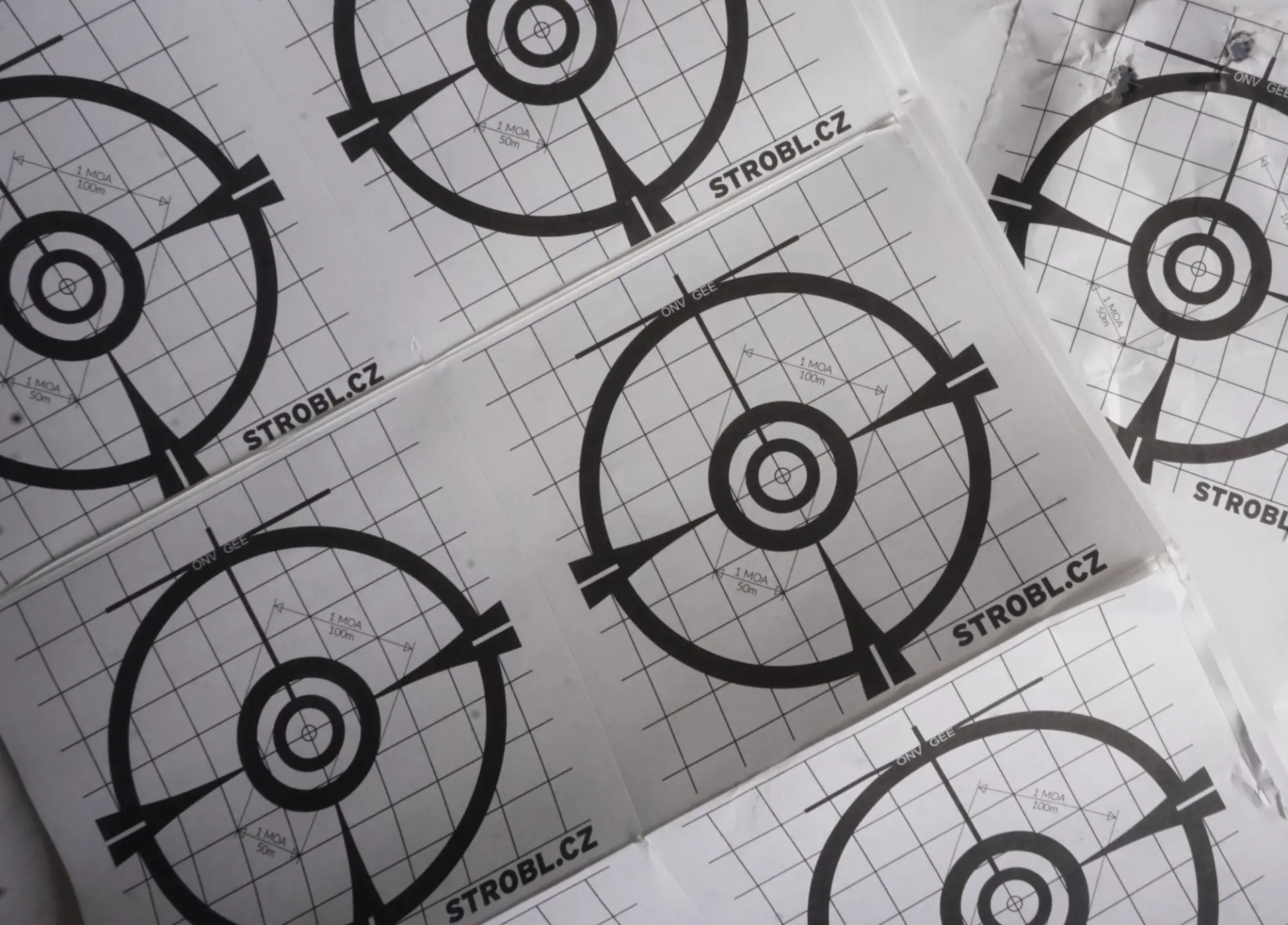 Detail of Strobl adhesive targets.
„When a two-layer high-contrast target is hit, the edges of the bullet hole peel back, making the hole appear larger and allowing easier shot reading at longer distances!“
 Birchwood Casey Shoot•N•C target. Note the difference compared to a hit in the backing paper.
Peels like an orange
Depending on lighting conditions, the quality of your riflescope, and your eyesight (including diopter correction), you may be able to read your hits on the target simply through the eyepiece. Beyond a certain distance, however, you’ll need a spotting scope, a camera, or to walk downrange to the target. To extend the distance at which you can still read hits without such aids, special “peel-and-reveal” targets are used, combining contrasting surface colors with an inner layer. Upon impact, the edges of the bullet hole peel back while the underlying layer slightly closes, making the hole appear larger and allowing hit identification at greater distances. A variety of designs from several manufacturers are available, typically adhesive, combining different colors and patterns; some feature zeroing grids or pasters made from the same two-layer “peel” material. Personally, I have experience with Birchwood Casey Shoot•N•C targets, which combine a black aiming point with a fluorescent green inner layer. In practice, they work very well, with the added benefit of good resistance to moisture. For reference, with a riflescope at 12× magnification, I am able to read hits from .223 Rem at a distance of 200 meters. The only downside is the higher price, which, depending on the type and size of the target, starts at 17 CZK per piece.
When the gong rings
A popular alternative to paper is shooting at steel plates, so-called gongs. They need to be hung on a stand, they are heavy, and due to ricochet risk you should keep a distance of at least 25 meters; some ranges do not allow their use at all. Precise shot reading is difficult and the initial cost is relatively high, but your investment is offset by many years of service life and immediate hit feedback thanks to the characteristic ring of a hit, which can carry for hundreds of meters. Moreover, a gong is visible in thermal imaging against the background, and the point of impact also “lights up,” so unlike a simple paper target, such a target can be used for zeroing thermal devices. Last but not least, shooting steel is simply engaging. Hit evaluation is still possible—you just need to bring spray paint to the range and repaint the target surface. However, it is certainly not an ideal target for precise scope zeroing and fine-tuning in millimeters. On the contrary, it serves perfectly for maintenance training. A wide range of gong profiles and sizes is available, including hunting-specific shapes of various game animals. I personally have good experience with Caldwell gongs. Hits on them can be heard at half a kilometer, and they are capable of withstanding projectiles with velocities up to 915 m/s and energies up to 4,745 J over the long term. In practice, they can handle even more powerful and faster loads, albeit with somewhat reduced service life.
 Thermal image showing visible impacts.
 Caldwell AR500 5" gong, measuring 16×14 cm, corresponding in size to a “hot” vital zone, priced at just 591 CZK.
 Birchwood Casey EZE-Scorer thermal target set.
Special for thermal imaging
As is well known, thermal optics cannot be zeroed on a standard paper target because the printed pattern is simply not visible. This can be addressed with the above-mentioned gong or with improvised DIY solutions. Some shooters stick aluminum foil onto the target (which does not work very well), or hang a metal plate heated with a lighter. However, professional solutions also exist. One of them is the EZE-Scorer target from Birchwood Casey. Essentially, it is a set of classic paper targets with a clearly readable zeroing grid and dimensions of 305×305 mm, supplemented with adhesive capsules of 76 mm diameter. Before use, you knead the capsule, after which it begins to generate heat of around 40 °C for 40–60 minutes. In thermal imaging, it is clearly visible at distances of up to 100 meters regardless of weather conditions, and its size allows for precise zeroing. The capsule is resistant to weather conditions, adheres firmly to the backing, and can withstand multiple hits—at least five can be expected, which is more than sufficient for zeroing. If the supplied backing target does not suit you, or if you want to save it, the capsule can be used on its own and attached to virtually any surface. It works very well, with no complaints from my side. The only drawback is the higher price compared to standard paper targets, although it is in line with others in its category. A pack with 4 targets and the same number of capsules costs a reasonable 259 CZK.
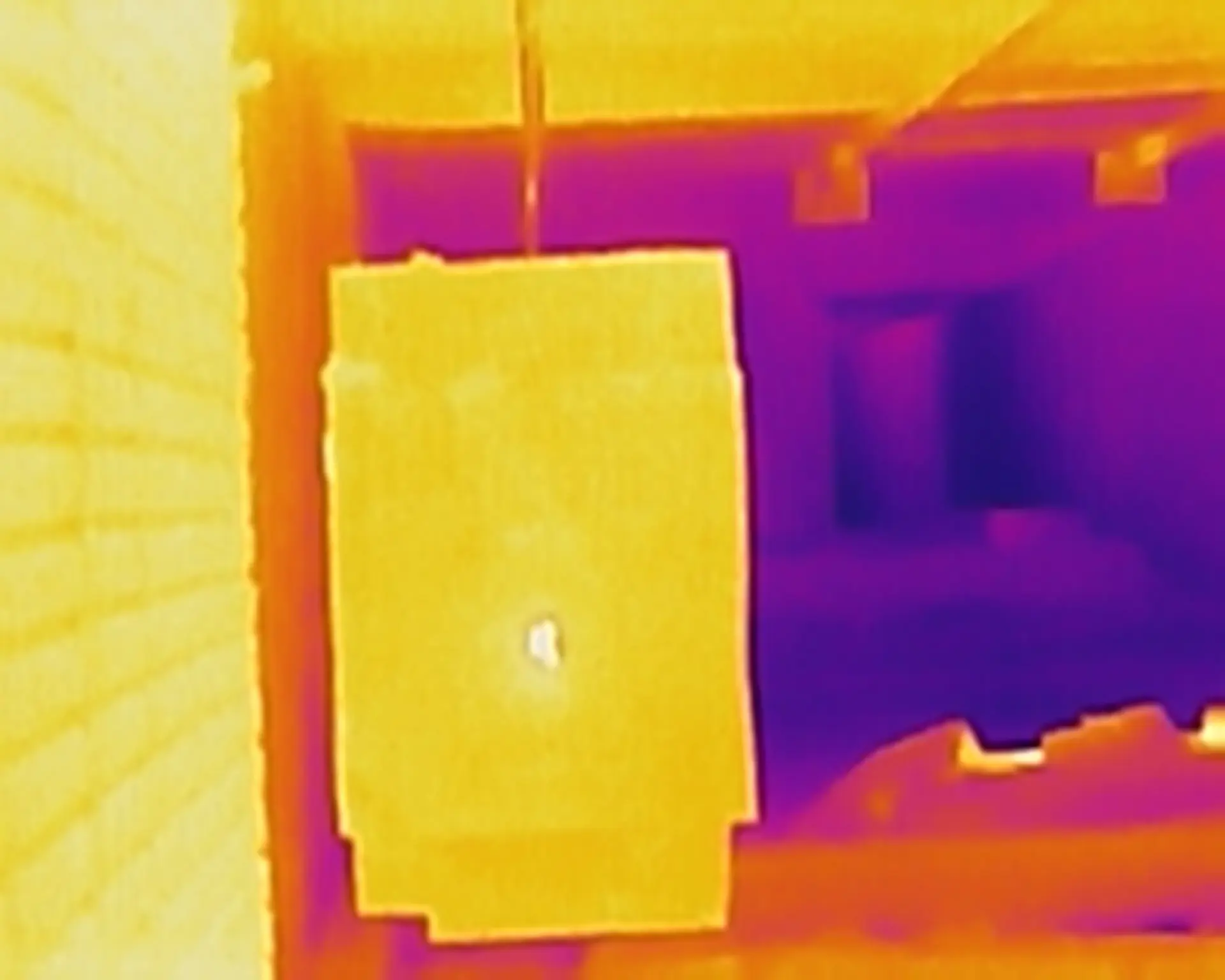 Activated thermal capsule captured in thermal imaging.
Recreational cubes
The English term “plinking” refers to shooting at non-standard targets, such as empty beer cans. It is primarily a recreational form of shooting, but certainly an enjoyable one. Target manufacturers also offer a kind of professional alternative in the form of various objects made from special ballistic polymer, which largely “self-seals” at the point of impact and is generally capable of withstanding significant damage over time. For this reason, they are sometimes referred to as “self-healing” targets. Caldwell offers two such targets under the name Duramax. They come in the form of a cube or a ball with an edge/diameter of 125 mm, reacting to hits by bouncing or rolling, so you can immediately register a hit. For light, fast projectiles, I recommend the more responsive ball. The cube can get caught on uneven ground and may not react much, but if you are using something more powerful and/or of larger caliber, it is the better choice, as it won’t jump far out of the impact zone. Duramax is, of course, not indestructible, but it can withstand up to the lower thousands of hits. Mine currently has an estimated 600 hits ranging from 9 mm Luger up to .444 Marlin, and it still happily bounces around the range in one piece. Regardless of the version, the price is 622 CZK, which, when calculated against its service life, is quite reasonable. One warning: do not use Duramax in freezing conditions, as it dramatically reduces its lifespan.
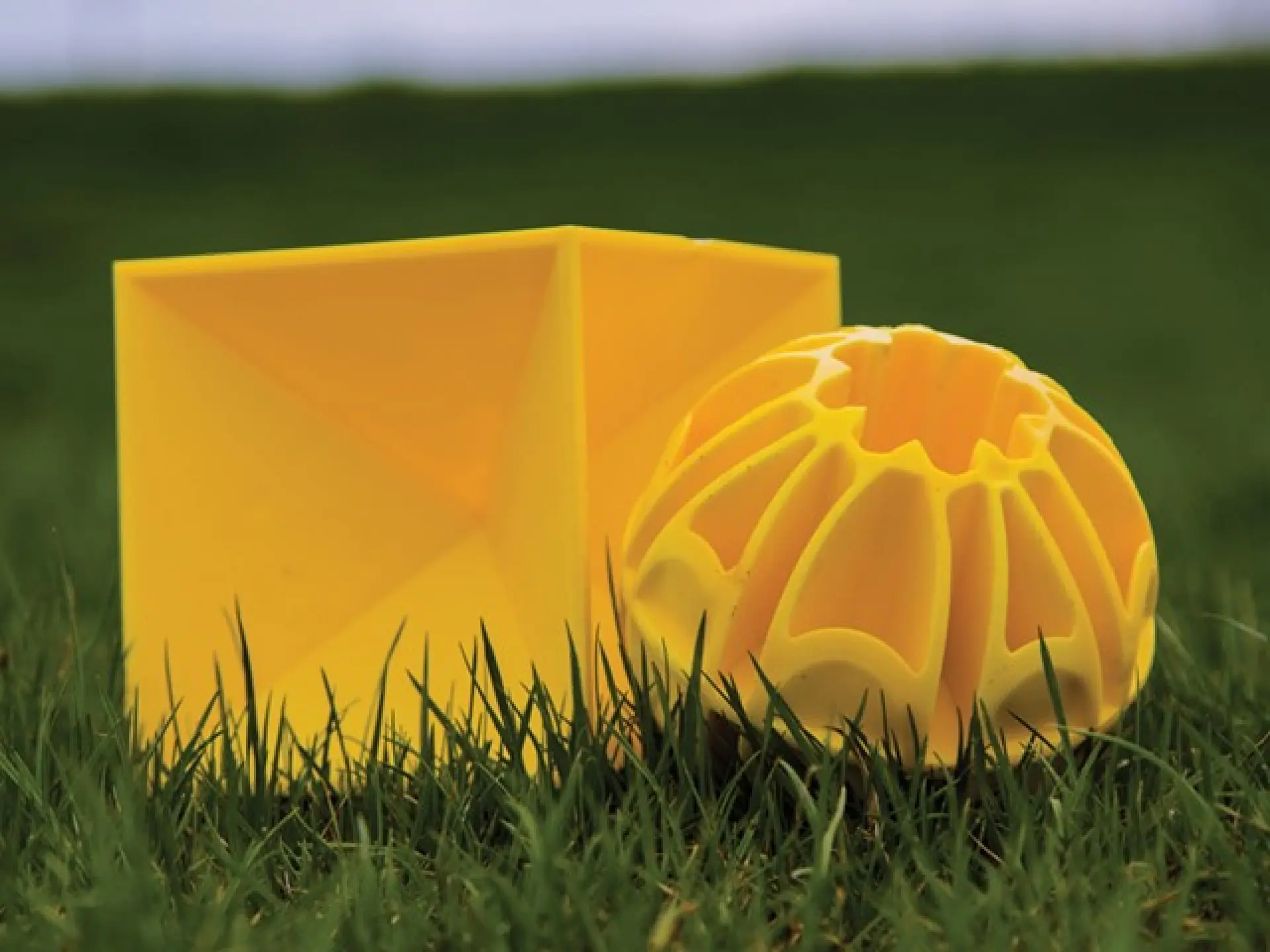 Caldwell Duramax.
 Birchwood Casey PREGAME target with a wild boar motif.
Realistic game targets
Paper targets do not have to feature only sport-style prints; they can also depict hunting scenes. Targets with deer or wild boar and a “bullseye” in the vital zone are slightly more expensive than standard pistol targets, but not by much, and they have been available for a long time. Building on this tradition are full-color photo-realistic targets capturing game animals in various conditions, angles, and natural backgrounds, usually combined with a clearly marked vital zone, including its irregular shape. Compared to older illustrated designs, the level of realism is much closer to reality, and the vital zone with an extra-highlighted heart gives you a clear indication of shot placement effectiveness. Of course, it is not 3D, so you still need to account for the shooting angle, but as a hunting-oriented training aid, it is certainly more beneficial than a standard target. In this segment, for example, the Birchwood Casey PREGAME series is available, with dimensions of 600×400 mm. The lineup currently includes 5 targets of various deer species in different angles, as well as wild boar, wolf, duck, turkey, and squirrel. Each target also features a smaller zeroing circle on the side. The paper used is robust and withstands rain better than standard targets, and a very useful feature is the two-layer high-contrast design, similar to the above-mentioned “peel-and-reveal” Shoot•N•C targets. Hits are therefore immediately visible through the riflescope, with color differentiation between hits to the vitals and peripheral hits. The only drawback is the relatively higher price of 175 CZK per target.
All presented targets can be purchased from STROBL.cz s.r.o. (see strobl.cz), from which we have also taken the prices listed in the text.
Photo sources: Author’s archive
Author: Tomáš Prachař
The article was originally published in Lovec magazine by Extra Publishing


