









Varmint Special
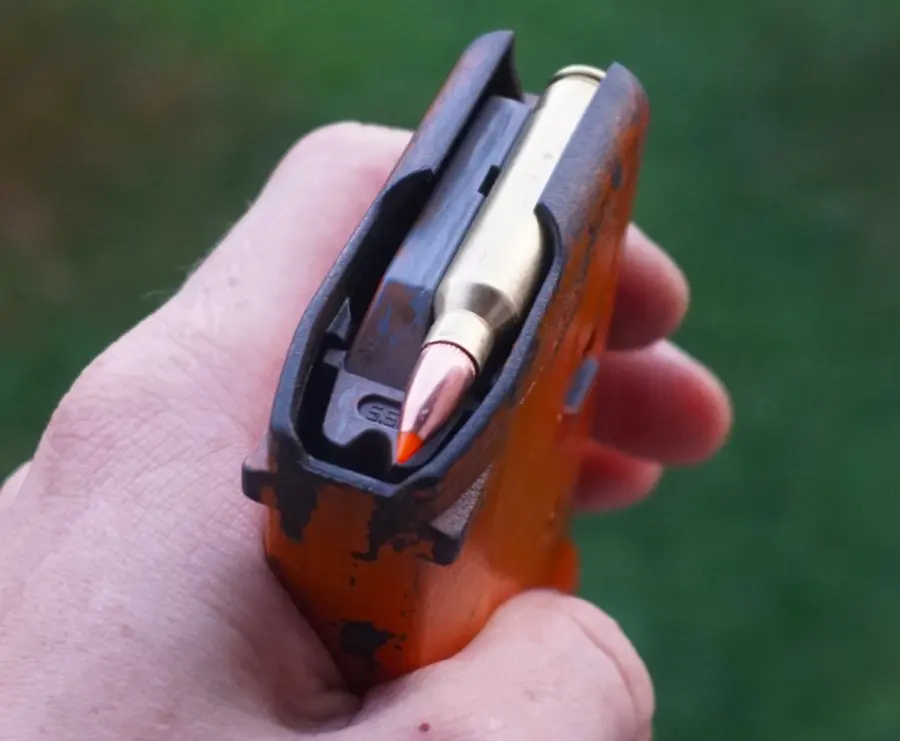

We tested Nosler Ballistic Tip bullets in the Varmint version for you, which indicates their specialization for small game and varmint shooting.
Intro photo – Nosler Ballistic Tip Varmint .224/60 gr in .223 Rem cartridge.
Under the Ballistic Tip name, Nosler offers several types of bullets. First and foremost, there is the Hunting version, a bullet with a lead core, shallow hollow cavity, and a polymer tip designed for medium to large game. The Varmint version is derived from it for varmint use. Those who prefer monolithic bullets can opt for the Ballistic Tip Lead Free, which we have already tested in one of our previous articles, and the lineup is completed by the Muzzle Loader version with a sabot, intended for muzzleloaders. In this article, we will focus on the Varmint version (hereinafter referred to as BTV) and evaluate its advantages, weaknesses, and overall usability.
Color coding
The Nosler Ballistic Tip Varmint bullet is available in ten variants, specifically (caliber/weight): .204/32, 40 gr, .224/40, 50, 55, 60 gr, .243/55, 70, 80 gr, and finally .257/85 gr. In all cases, the design is a spitzer bullet with a lead core, a boat-tail base, a deep hollow cavity fitted with a polymer ballistic tip, and an extra-thin jacket that slightly thickens toward the rear to ensure integrity at all practically achievable velocities. An interesting feature is the tip color, which varies by caliber from red through orange and purple to blue. This is not entirely common, as it complicates clear identification for the shooter as well as the manufacturer’s marketing potential. Nosler materials claim that the color spectrum helps visually distinguish different calibers, but if a hunter keeps a specialized varmint rifle in their arsenal, they usually stick to one model and caliber. Moreover, cartridges can generally be more easily distinguished by case shape, so I do not see much advantage in color differentiation of the tip. On the other hand, in normal hunting practice, it is unlikely to cause any issues. From a design standpoint, there is an unusually thick jacket layer at the base of the bullet to ensure greater strength. We had the opportunity to test the .224/60 gr variant, which is the only one in the lineup to feature a cannelure compared to the otherwise smooth surface. As expected from Nosler, manufacturing quality is excellent in terms of surface finish and virtually negligible weight deviations.

A special feature of this bullet line is the color-coded tip depending on caliber.
Factory ammunition
Nosler also caters to those who do not handload and offers factory-loaded ammunition using BTV bullets under the same name. However, you can choose from only seven options (cartridge/bullet weight): .204 Ruger/32, 40 gr, .22 Nosler/55 gr, .223 Rem/55 gr, .22-250/55 gr, .222 Rem/50 gr, and .243 Win/70 gr. Performance-wise, these are quite “hot” loads; for example, the .223 Rem variant reaches a muzzle velocity of 945 m/s, and I would have no concerns about quality and accuracy, which are traditionally at a high level for Nosler ammunition. The downside is limited availability. Currently, no local retailers have them in stock, so a special order will likely be required (the brand is imported, for example, by proarms.cz) with a longer lead time. Additionally, factory Nosler ammunition belongs to the more expensive segment, and the BTV line is no exception.
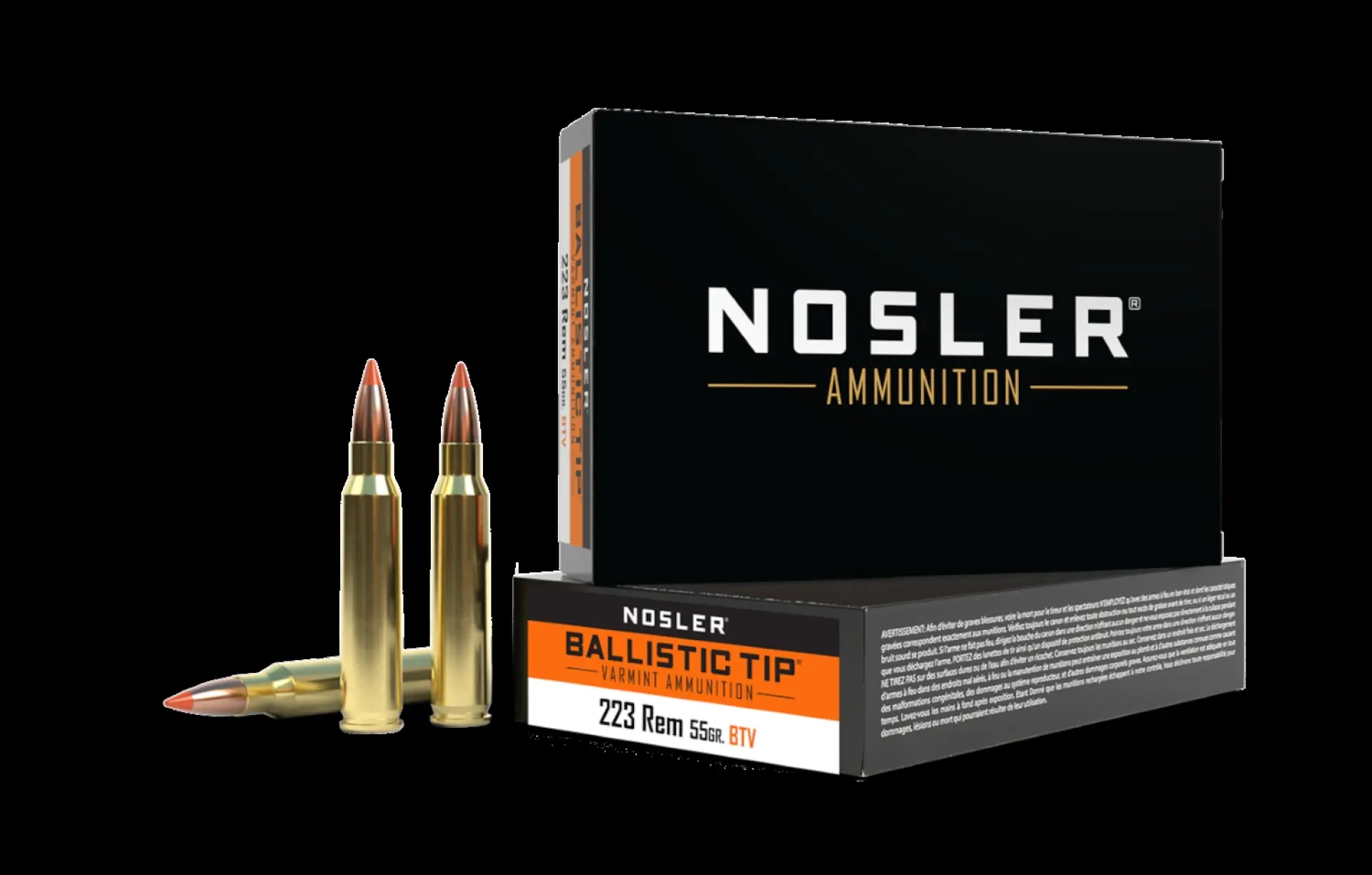 Factory-loaded Nosler ammunition featuring the Ballistic Tip Varmint bullet.
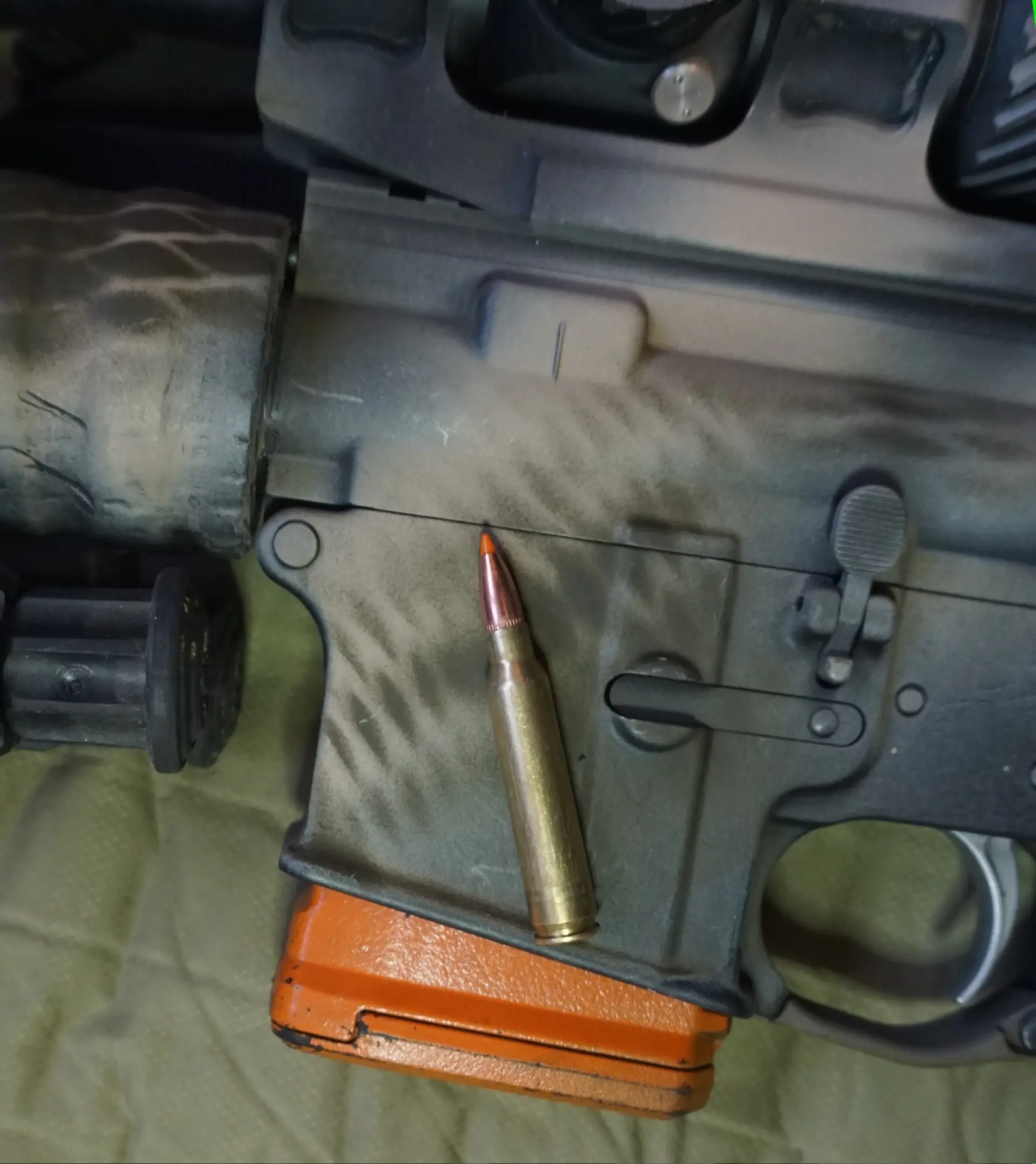 The bullets were tested in combination with an AR-15 SPR-type rifle.
At the range
Reloading itself is not particularly tricky; the polymer tip feels somewhat softer, but during reloading, normal handling, and impacts in the magazine during firing, it retains its geometry without permanent deformation. However, the Varmint proved to be relatively sensitive to tuning, as I observed fairly large differences between the configuration with the best grouping and the others. A verdict based on experience with one bullet variant fired from two rifles has limited conclusiveness, but it is possible that you will need more thorough load development with the Varmint. As usual, I tested a wide range of configurations, and the best result was achieved with a charge of 26 gr of Vectan SP7 powder, an overall cartridge length of 57.4 mm, and a “jump” (distance to the lands) of 0.6 mm. The bullet was primarily tested in an AR-15 SPR-type semi-automatic rifle. From a 457 mm barrel, in combination with a short suppressor, I achieved a radar-measured average velocity of 917 m/s.
 Example of a group at 100 meters.
What it can do
As already mentioned in the introduction, the BTV bullet is intended for small game and varmint shooting. The design is engineered to handle even extremely high velocities typical of some varmint calibers, while delivering a flat trajectory and ensuring quick, reliable kills even with less-than-ideal shot placement through rapid deformation transitioning into fragmentation. The manufacturer states that a minimum impact velocity of 488 m/s is required for optimal terminal performance, while the upper limit is not specified; however, at very high velocities, it cannot be considered pelt-friendly. For varmint use, this is not a major issue, but if you are shooting foxes or marmots and wish to preserve the hide as much as possible, you may have to deal with more extensive damage. On the other hand, there are even more aggressive bullets on the market. Compared to the iconic Varmageddon—also from Nosler—the BTV is still relatively moderate. Personally, I have so far taken only one hare and one nutria with it—as opportunities for small game are relatively rare for me—but I can report that in my .223 Rem the terminal effect is acceptable in terms of game damage while remaining fully effective. In both cases, the bullet acted as an instant “switch-off,” which is not surprising. Examination of the game and my range tests in a clay block confirmed a tendency toward fragmentation, making it less suitable if you intend to consume the game afterward. I am convinced that, aside from small game and varmints, it could also be successfully used for roe deer, but due to the aforementioned destruction, it would be wasteful unless you are strictly taking headshots.
Ballistic Tip Varmint, like other Nosler bullets, can be purchased from STROBL.CZ s.r.o. More information can be found at strobl.cz, or directly on the manufacturer’s website nosler.com
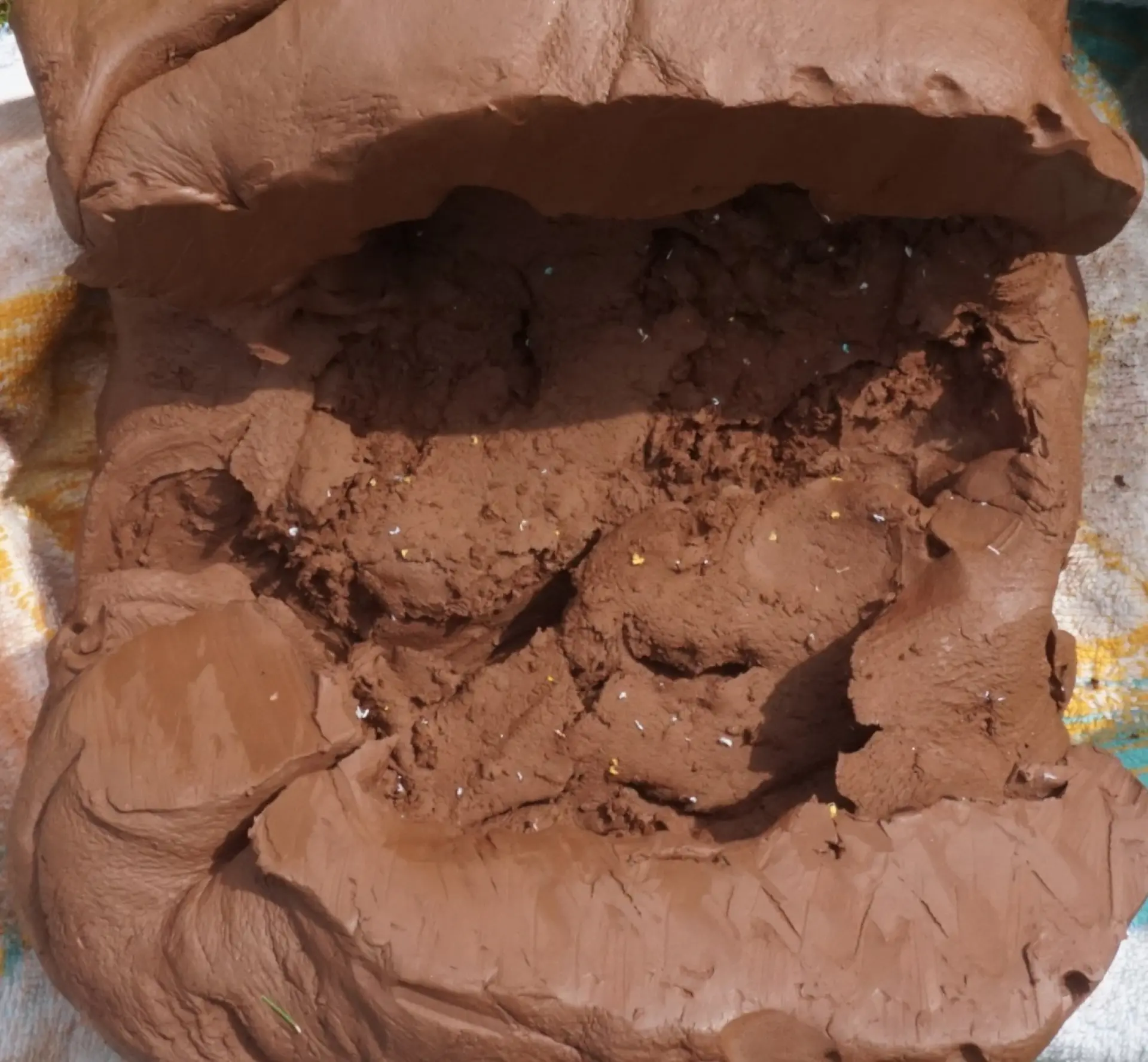 Test firing into a clay block, as well as hunting practice, demonstrated the bullet’s tendency to fragment.
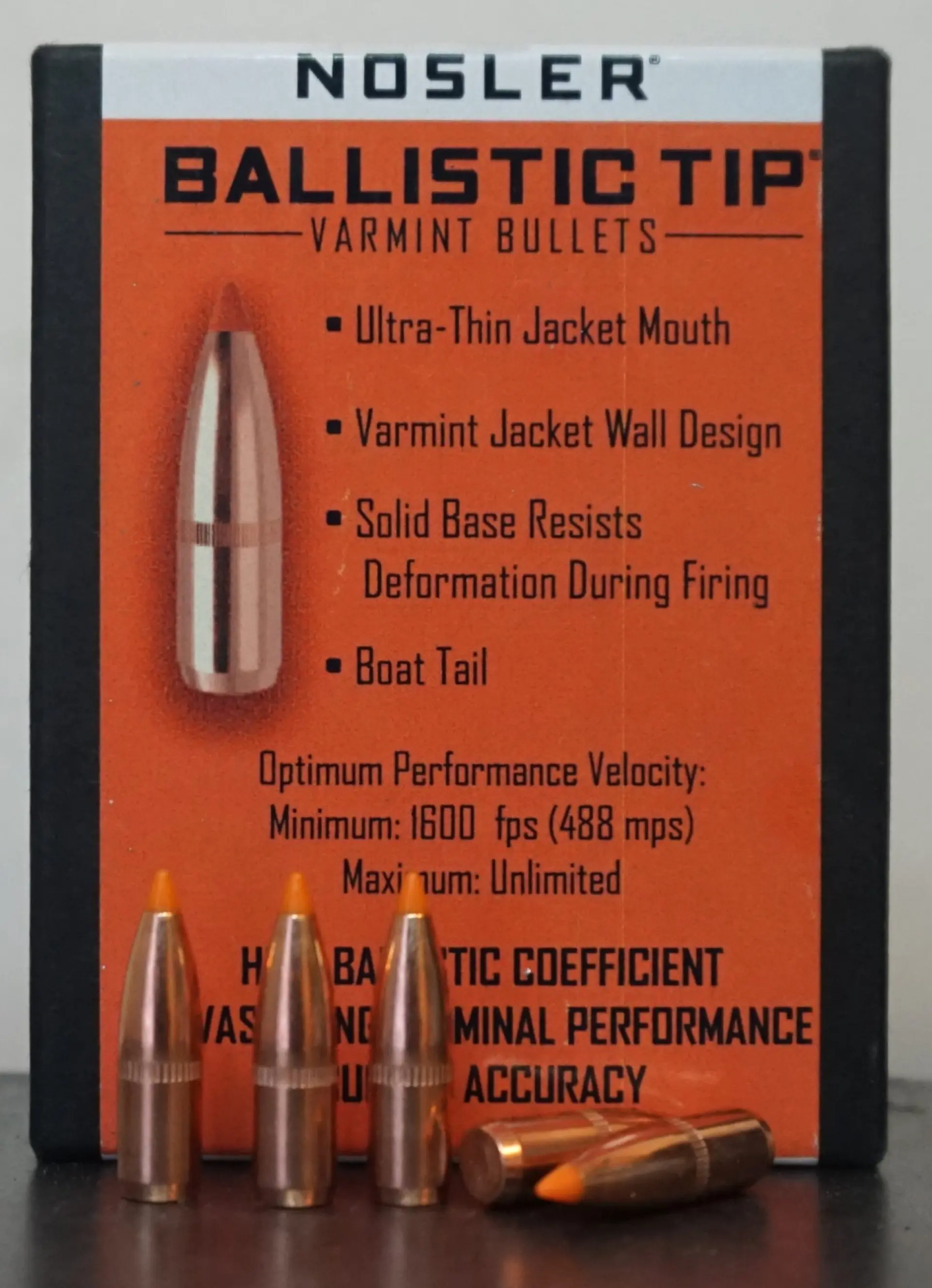 Bullets are typically packaged in 100-piece boxes (selected variants are also available in 250-piece packs).
Summary
The price ranges from 9.1 CZK for the .224/40 gr variant in bulk packaging of 1,000 pieces up to 15 CZK for the .257/85 gr bullet in standard 100-piece packaging (selected variants are also available in 250-piece packs). The tested version cost 11.7 CZK per piece.
Within the manufacturer’s lineup, the BTV competes with the aforementioned Varmageddon bullets, also designed for varmint use, which are offered in a wider range of variants up to .311 caliber and are slightly cheaper, by about 2 CZK per bullet. On the other hand, you get greater target moderation and, in my experience, slightly better accuracy and ballistics thanks to a higher coefficient (BC .255 vs. .267 in the .223/55 gr variants).
The main competitor on the current market is the Hornady V-Max, which I have also had the opportunity to shoot. In terms of design, accuracy, ballistics, terminal effect, and price, they are essentially equivalent. The decision of which bullet to choose will therefore depend on availability and personal brand preference. Of course, it also applies that different firearms “prefer” different bullets, so you may achieve worse grouping with Nosler than with Hornady, and vice versa. The only advantage of the V-Max is the availability of factory-loaded ammunition, see the relevant box.
Pros/Cons
+ accuracy
+ quality
+ terminal performance
- relatively narrow application
- higher price
Photo sources: author’s archive, manufacturer materials: nosler.com
Author: Tomáš Prachař
Originally published in Lovec magazine by Extra Publishing